
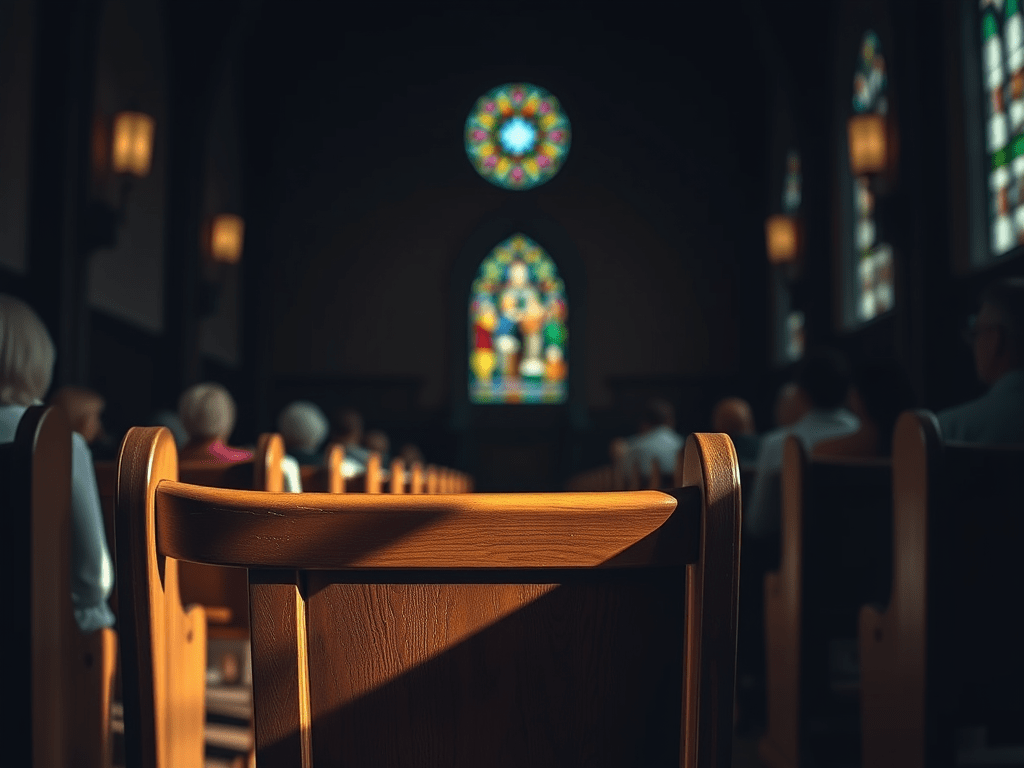
It seems like an invitation to the limelight or invisibility veil in the silence of a Sunday Mass, as masses are queued-up to take the Eucharist. This is what that quiet choice changed my perception of grace, humility, and remaining faithful within a community of believers.
The pew, which was made of wood, creaked and creaked as I stood up, and as the congregation rose as one great sea of bodies. I stood still, clasped my hands in my lap and my heart had the rhythm of a confession. He had looked about–had the usher seen? The family beside me? This was my third such Mass, and it was rather a pause of doubt than of disobedience. At that point I was not denying the Church, I was respecting my conscience, murmuring questions too crude to ask in church.
This essay explores how sitting out Communion—far from signaling alienation—can paradoxically strengthen one’s faith by embracing honesty, humility, and persistent presence in the community, drawing on personal experiences, Church teachings, and shared testimonies to show that restraint is a valid path to grace. It is the contemplation of the existing tension of sitting out Communion: the internal tug-of-war of personal truth versus the public ritual. I will explore how this exclusion can end up being counter-intuitive to affirm faithfulness using my experiences which are supported by teachings in the Church and collective stories. Many of us are literally and figuratively lurking in the back pews, trying to find a place to belong in the times of uncertainty, where 16 percent of the U.S. Catholics every Sunday in the surveys do not receive Communion at Mass. My hope? In order to comfort the readers that restraint is a kind of devotion which can transform shame into silent grace.
The Silent Calculation: Why I Stayed Seated
It started subtly, in a Lenten Mass of 2024. I was still mourning a divorce that had subjected me to doubts about what remarriage teaching had to say and I felt unworthy, not necessarily of the mortal sin, but somewhere in a gray area of unclear conscience. The use of the Catechism encourages the pre-Communion examination: “Anyone who knows of a grave offense must be reconciled to the sacrament of Reconciliation before coming to the Communion (CCC 1385). I had not broken my confession, not because I had concealed it, but because my doubts needed air, not absolution yet.
Sitting out felt exposed. As people passed me, I wondered what the word was about them: What is her story? But in such visibility I had sincerity. Canon 916, which is defined in the laws of the church, guides those who are aware of having committed grave sin because they should avoid abusing the sanctity of the sacrament. In my case it was not a big sin but an appeal to authenticity, the refusal to act like something I am certain of, as I later considered. Personal testimony confirms this: One Redditer has recounted that they were changed upon the abuse by the clergy, and chose to forgo Christmas Mass as a survival mechanism rather than a form of defiance.
It is this tension that brings out the role of conscience. According to the U.S. Conference of Catholic Bishops (USCCB) it is our most secret centrality where God speaks and is created by means of prayer, sacraments, and reflection. The only thing I could do was abstinence, reforming the exclusion as penalty to meaningful inactivity.
Seen and Unseen: The Weight of Public Ritual
Halfway through a full Easter Vigil, the irony dawned on me: In a rite of resurrection, I felt buried in the pew. Bodies were moving, and incense was thick in the air and murmurs of Amen. Retiring increased loneliness–invisible in my conflict, but seated coincidentally. It is an old saying; as Philippa Martyr of The Catholic Weekly says, sitting out may be tantamount to being left out, but it is not a punishment of God, it is the result of decisions, and it will render humility.
This is not unusual according to surveys. Pew Research discovered that 16 percent of Catholics do not ever attend Mass Communion, usually because of some doubts or life events such as divorce or irregular union. There are many reasons: mortal sin, lack of fasting, conscience problems. In my case, it was the latter, the struggle with doctrines of sexuality that had a contradiction to my reality. However, being there reversed the story: Not going away, I occupied the room, and being faithful to myself, as I was present alone.
Voice of the theology attests to this. According to Commonweal Magazine, conscience is a sacred manifestation of human dignity, and is to be followed in making moral choices, such as in the reception of Eucharist. The early Church fathers, such as St. Ignatius of Antioch exhorted people not to consume it when they could not confess the Real Presence in full- the act of protection, not the act of exclusion. This history was a consolation in my pew: My moderation praised the mystery, even in unbelief.
Redefining Grace: From Exclusion to Embrace
With months sitting out graduated to revelation. During one of those solitary weekday Masses, when there were fewer eyes, I thought about grace, not as recompense of faultless attendance, but as an undeserved gift of irregularity. The lesson of humility: To confess that one was not ready, was as close as the Prodigal son to his restoration, as gritty and deadpan as it was.
This is supported by mutual testimonies. One of the writers in Catholic Stand calls abstinence as good witness and that he chooses integrity rather than unworthiness until he confesses. A third one, rejected as a child, regarded it as loving correction. These narratives demonstrate that being out of place can make them more faithful and the pew is almost a confession stand.
Greater statistics highlight the crisis: A 2019 poll by Pew revealed 69% of Catholics celebrated the Eucharist without considering it literally, which is connected to low belief. However, scholars such as the one at the University of Notre Dame claim that it can be rejuvenated through theological formation-through conscience. In my case, abstinence inspired the following: Doubt did not push me away; it ushered me into self-examination, where grace is flowing out of the rail.
But challenges linger. Hope does not shine to everyone, some persons feel that they are always marginalized. In contrast, the Church focuses on Reconciliation as the way back but not as an everlasting wall. My journey? It taught survival by telling the truth and that being part of something means not everything or nothing.
Your Turn: Finding Space in the Back Pew
In the event that this rings true, the following suggestions may be attempted:
- Look into conscience before Mass, with reference to such aids as the elaborate checklist of the Bulldog Catholic.
- Be there anyway- it counts, according to USCCB, to create conscience by community.
- Find community: Reddit and other similar communities have posts like these; you are not the only one.
- Reflect hopefully: Just like the early Christians did, pray and devote to sacraments.
Ultimately, the Communion with empty hands could not empty my faith; it filled it with strong grace. When you are absent, remember that you have a seat in your pew, with all its vagaries.





 Sure Media Magazine
Leave a comment