
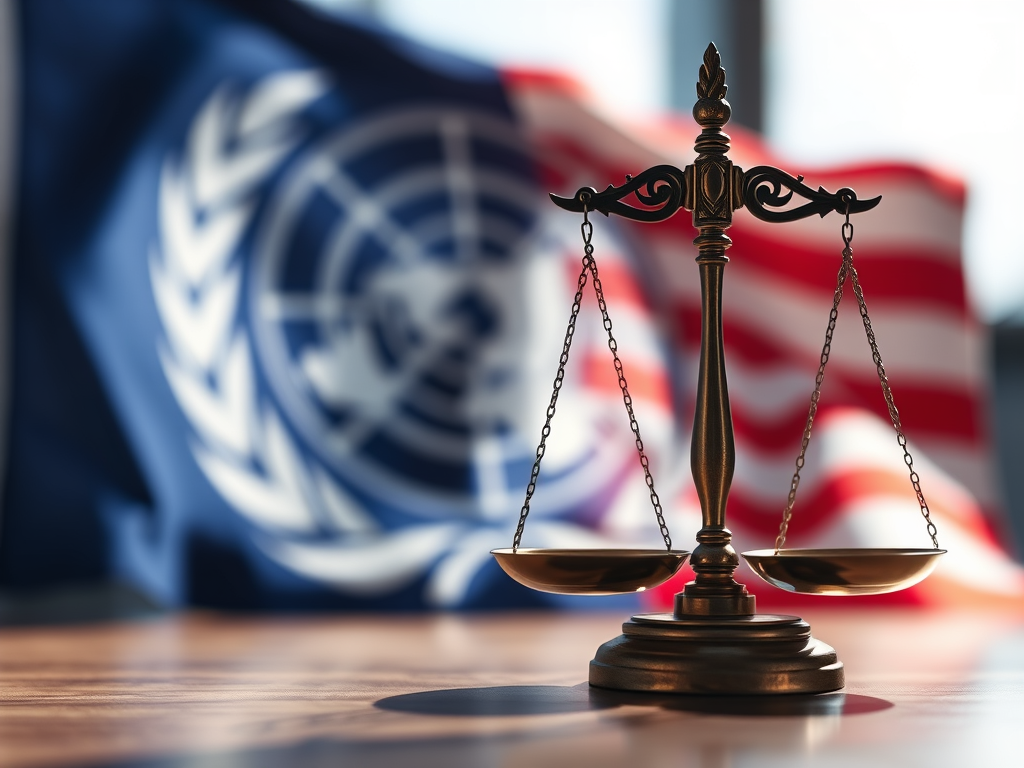
As the world grows more cynical, the U.S. proudly proclaims the idea of a “rules-based order” and then opts out of key norms together with its allies. In this analysis, the patterns of the vetoes, arms sales, and the opt-out of treaties have been exposed and the hypocrisy in the structures and how this has affected the Global South is revealed.
During a tense meeting of the UN Security Council last week, the ambassador of Russia displayed a sign that read, “Here is your rules-based order,” to criticize U.S. actions in Venezuela as the most extreme form of double standards. With Washington gloating about the capture of Nicolás Maduro as a victory over tyranny, the same words are heard in the Global South capitals, where leaders lament the vigorous upholding of the sovereignty in Ukraine by America, but not the atrocities committed in other countries.
This article breaks down the fact that the U.S.-dominated rules-based international order does not operate as a blanket but as a discriminatory instrument, ensuring compliance with foes but allowing latitude to the hegemon and its allies. Supported by official documents, professional commentary, and a world opinion, it follows the discrepancies of implementation, ranging, on one side, through UN vetoes to arms transfers, and explores how this undermines trust, which calls for multipolar alternatives in an increasingly polarized world.
Rhetoric of Universality, Practice of Exception
The U.S. officials constantly use the phrase of the rules-based order to support the global stability, including laws, norms, and institutions such as the UN Charter. Secretary of State Antony Blinken in a 2022 speech referred to it as a system to manage relations between states, prevent conflict, and safeguard rights, grounded on common aspirations. But according to critics, this rhetoric is used to hide the fact that rules are not equally applied. In one of the analyses, the term permits rule-picking and exception-management, which puts the U.S. interests before consistency.
This cherry-picking is not recent but it has been exacerbated by threats of Russia and China. The National Security Strategy of the Biden administration refers to the order 50 times making it appear as a threat of autocrats. Nonetheless, the U.S. actions which include its withdrawal of treaties like INF and the Paris Agreement contradict the same behavior which it promotes.
Tools of Selective Enforcement
The U.S. selectively uses the international law using a number of mechanisms.
- Non-ratifications of treaties: America is a signatory of major treaties, such as the Rome statute of the ICC, the Law of the Sea convention and the Biological diversity Convention, which have not been ratified by the country. Since 1949, more than 15 treaties have been rejected by the Senate, and in many cases on grounds of sovereignty. This enables Washington to enjoy the international standards without complete responsibility.
- ICC exceptions: The American Service-Members Protection Act 2002 does not allow U.S. cooperation with the ICC and gives power to release imprisoned Americans by force. As much as the U.S. will welcome ICC investigation of its enemies such as Russia, it would not submit to ICC jurisdiction over the U.S. or its allies such as Israel.
- UN Security Council vetoes: The U.S. has been a heavy vetoer of at least 49 resolutions by the UN Security Council that have been critical of Israel since 1970. This protects allies against being censure over matters such as settlements, while Washington criticizes Russian veto over Syria.
- Weapons sales: Although legislation exists barring the sale of arms to perpetrators of human rights, the U.S. has given its allies such as Saudi Arabia billions of weapons in the course of the conflict in Yemen. A report of 2024 indicates that such transfers are violating the Arms Trade Treaty, one of the causes of abuses.
- Sanctions norms: The U.S. punishes its competitors, such as Iran and Russia, but seldom its allies, even in cases of infractions.
Case Comparisons: Ukraine vs. Gaza and Beyond
Nowhere is selectivity starker than in contrasting crises.
Perceptions in the Global South: Erosion of Trust
This legal apartheid is skeptical in the Global South. In a 2023 Foreign Policy analysis, the Western reaction to Gaza in comparison with Ukraine has been accused of hypocrisy, which has estranged other countries, such as India and Brazil.
Lessons for a Multipolar World
To rebuild credibility, the U.S. could ratify key treaties, curb vetoes, and condition arms sales on rights compliance. But with multipolarity advancing, the Global South’s push for equitable norms may redefine the order altogether.
As challenges mount—from Venezuela to potential Greenland tensions—the U.S. must decide: cling to selective enforcement, or embrace true universality? The world watches, increasingly unwilling to play by rules that bend for the powerful.





 Sure Media Magazine
Leave a comment