
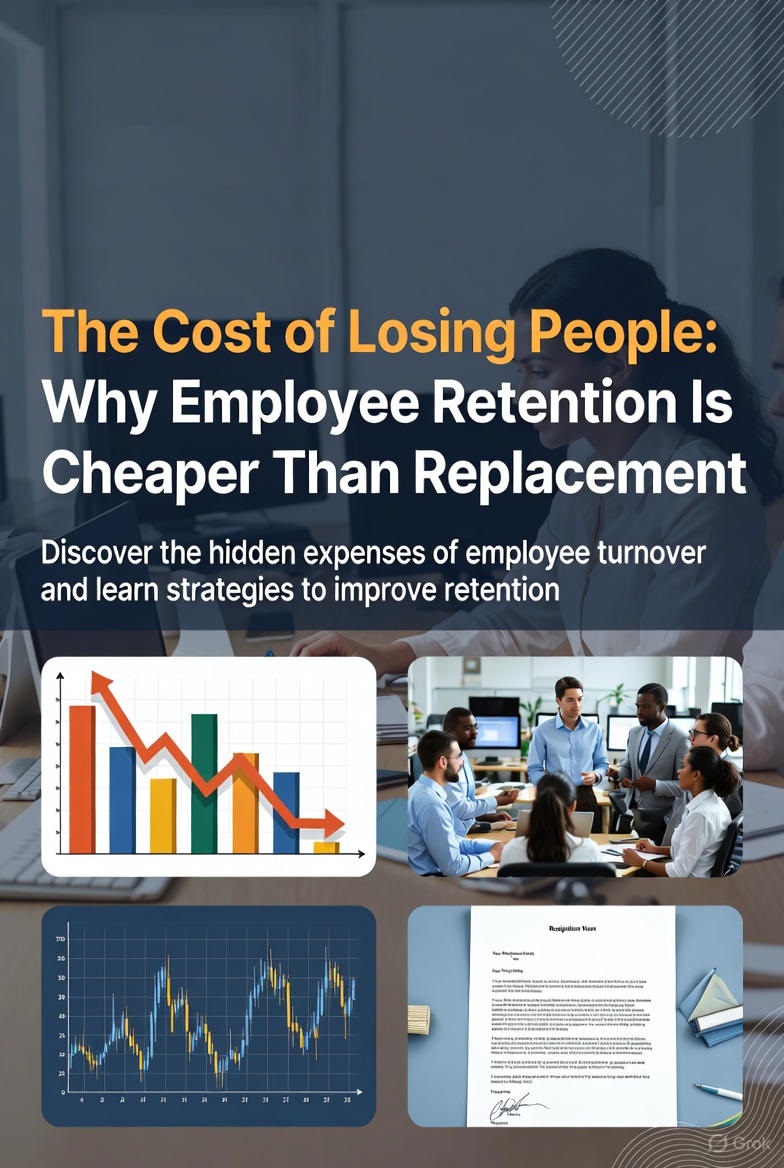
Employee turnover is often discussed in terms of resignation letters and exit interviews. Rarely is it examined as a compounding loss – one that begins long before an employee leaves and continues long after a replacement is hired. While companies obsess over salary costs, they consistently underestimate the true price of losing experienced people. Retention is not a “soft” HR issue. It is a financial, operational and cultural one.
The Hidden Financial Cost of Replacement
When an employee resigns, the immediate reaction is often to “find a replacement.” What follows is an expensive and time-consuming chain of events:
- Higher remuneration demands from the replacement often exceeding what the former employee requested
- Time lost conducting interviews, shortlisting and approvals
- Recruitment fees, advertising costs or agency commissions
- Hotel bookings, flights and logistics especially in overseas recruitment
- Local onboarding expenses: visas, IDs, medical tests, insurance, relocation

All of this investment is made without any guarantee of completion. At any stage, the potential hire can withdraw, accept another offer, change their mind or fail compliance checks all that with with no consequences on their side. The company, however, absorbs the full loss. Ironically, many of these costs would have comfortably covered a long-overdue increment, promotion or role adjustment for the departing employee.
Experience Is Not Transferable at Will
A role description may look static on paper, but in reality, jobs evolve around the people who occupy them.
Long-serving employees accumulate:
- Institutional knowledge of systems and history
- Proven workarounds that maintain efficiency
- Deep context on clients, past decisions and pitfalls
When they leave, companies assume a replacement can “pick up where they left off.” This is rarely true.
Most roles become person-specific over time. Responsibilities shift, systems change, and informal expertise develops. A new hire, even a highly qualified one, is not stepping into a vacuum, they are stepping into a network system shaped by someone else. Productivity lags and gaps are inevitable. Some are permanent.
Relationships Don’t Come With the Job Description

One of the most underestimated losses is internal social capital.
An employee who has worked in a company for years has:
- Established trust across departments
- Informal and efficient communication channels
- Credibility earned through delivery and consistent results
- An understanding of “how things really get done”
A new joiner starts from zero.
They must learn personalities, office politics, approval flows and unspoken rules often through trial and error. This adjustment period is costly, not just in time but in friction, mistakes and delayed outcomes. Processes can be documented. Relationships cannot.
Loyalty Is Usually Broken, Not Absent
Long-term employees who resign are rarely impulsive or disloyal. More often, they leave after enduring long periods of frustration:
- Being overlooked for promotion
- Being passed over during increments
- Having responsibilities expand without recognition
- Feeling unheard despite clearly communicating their needs
By the time they submit a resignation, they have usually tried ,quietly, to stay.
This is where companies lose twice:
- They ignore or minimize feedback when it matters
- They later pay a premium to replace what they failed to value
In many cases, a simple acknowledgment, a role review or a transparent conversation would have been enough to retain the employee and avoid the cascading losses that follow.
The Margin Call Moment: When Companies Pay Too Late
There is a telling scene in the movie “Margin Call” that mirrors modern employee attrition perfectly. After ignoring internal warnings, the firm realizes it is sitting on catastrophic risk and the only person with intimate knowledge of the issue has been laid off. To bring him back, they go to great lenghths to locate him, to placate him, threaten him, promise him and eventually agree to an absurdly high consulting rate, calculated per hour by the same employee, not to work, but to sit quietly and cooperate while the company liquidates its toxic assets.

The message is clear:
We could have listened earlier. Now we can only afford silence.
This is how many organizations treat experienced employees who leave. While employed, their concerns are dismissed as complaints. Once gone, their absence exposes just how much undocumented knowledge, stability and risk management they carried.
Suddenly, companies are willing to:
- Pay consultants multiples of the former salary
- Beg for short-term “handover support”
- Offer inflated rates for temporary continuity
- Quietly acknowledge the value they refused to recognize
What could have been retained through respect, recognition or progression now costs exponentially more and still delivers less. Like Margin Call, the real tragedy isn’t the money lost. It’s that the loss was entirely avoidable.
Conclusion: Retention Is Strategic, Not Sentimental
Employee retention is not about comfort or entitlement. It is about:
- Protecting institutional knowledge
- Preserving momentum
- Avoiding unnecessary financial leakage
- Honouring value before it walks out the door
Replacing people is easy. Replacing experience, trust and loyalty is not. Companies that understand this do not wait for resignation letters to act. They recognize that the most expensive employee is often the one who just left and thecheapest investment is the one they never made in keeping them.
References
Applauz — Costs of Employee Turnover
Explains comprehensive turnover costs: recruitment, productivity loss, onboarding, training, and hidden organizational costs beyond just salary.
https://www.applauz.me/resources/costs-of-employee-turnover
Joinforma — Employee Replacement Costs
Breaks down actual expenses in replacing an employee, including advertising, screening, and onboarding costs.
https://www.joinforma.com/resources/employee-replacement-costs
PeopleKeep — Real Cost of Losing an Employee
Focuses on retention investments vs. replacement costs and how retention yields better ROI.
https://www.peoplekeep.com/blog/employee-retention-the-real-cost-of-losing-an-employee
Gallup — Real Cost of Losing an Employee
Data on how turnover impacts performance, customer experience, and corporate outcomes.
https://www.gallup.com/workplace/236366/real-cost-losing-employee.aspx
Lano — True Cost of Employee Turnover
Expands on hidden indirect costs like interruption of work, management time, and lost opportunities.
https://www.lano.io/blog/the-true-cost-of-employee-turnover
HR Morning — Real Cost of Employee Turnover
Discusses time-to-fill and effect on team productivity, validated by HR professionals.
https://www.hrmorning.com/articles/real-cost-employee-turnover/
EmployBridge — What is the Cost of Replacing an Employee
Provides staffing industry perspectives on replacement costs.
https://www.employbridge.com/blog/workforce-management/what-is-the-cost-of-replacing-an-employee
Payactiv — Cost of Replacing an Employee
Highlights financial stress on organizations from recruitment to ramp-up time.
https://www.payactiv.com/blog/cost-of-replacing-an-employee/
Wharton Knowledge — Why Turnover Costs More Than You Think
A business school analysis showing why replacement costs often exceed expectations.
https://knowledge.wharton.upenn.edu/article/why-employee-turnover-costs-more-than-you-think/
Reworked – Brain Drain and Knowledge Loss
Explores how turnover dissolves institutional memory and makes companies less resilient.
https://www.reworked.co/knowledge-findability/brain-drain-the-impact-of-high-turnover-on-institutional-knowledge/
Emerald Journals – Impact of Knowledge Loss
Academic study measuring the effect of knowledge loss over time.
https://www.emerald.com/insight/content/doi/10.1108/TLO-09-2022-0107/full/html
ResearchGate – Measuring Impact of Knowledge Loss
Longitudinal research confirming permanent productivity gaps post-employee exit.
https://www.researchgate.net/publication/323320324_Measuring_the_impact_of_knowledge_loss_a_longitudinal_study
McKinsey – Hidden Costs of Knowledge Loss
Consulting firm insight on how turnover affects performance and competitive advantage.
https://www.mckinsey.com/capabilities/people-and-organizational-performance/our-insights/the-hidden-costs-of-knowledge-loss
PMC/NCBI – Workplace Social Capital
Peer-reviewed insights into the value of intra-company trust and networks.
https://pmc.ncbi.nlm.nih.gov/articles/PMC9367717/
Vantage Circle – Social Capital in the Workplace
Breaks down how relationships reduce friction and improve efficiency.
https://www.vantagecircle.com/en/blog/social-capital-in-the-workplace/
PubMed – Processes vs. Relationships
Medical/organizational study highlighting that documented processes don’t replace relational capital.
https://pubmed.ncbi.nlm.nih.gov/35954943/
Bonusly – Cost of Employee Turnover Stats
Infographic-rich resource summarizing turnover cost data.
https://www.bonusly.com/post/cost-of-employee-turnover
Workhuman – Employee Retention Statistics & Insights
Data-backed insights on retention best practices.
https://www.workhuman.com/blog/employee-retention-statistics/
IMDb — Margin Call
Used as an analogy: ignoring risk until it’s costly.
https://www.imdb.com/title/tt1615147/
Quotes/scenes underscoring “too late realization of value.”
https://www.imdb.com/title/tt1615147/quotes/





 Sure Media Magazine
Leave a comment