

- Research suggests slow travel, emphasizing immersion and extended stays, reduces stress for about 62% of travelers while fostering deeper cultural connections.
- It promotes sustainability by lowering carbon emissions through fewer flights and more local transport, potentially cutting transport-related GHG by up to 90% when opting for trains.
- Evidence leans toward economic benefits, with slow travelers spending up to 60% more in local economies, supporting small businesses amid global tourism’s projected $16 trillion GDP contribution by 2034.
- Psychological perks include enhanced mindfulness and reduced anxiety, though experiences vary by individual; it’s seen as a counter to fast-paced life, encouraging presence without controversy over its accessibility.
- In 2025, trends show rising interest in “detour” and secondary-city explorations, with 74% of travelers seeking local recommendations for authentic, less-crowded experiences.
What Slow Travel Entails
Slow travel prioritizes depth over distance, involving longer stays in fewer spots to absorb local rhythms and build connections. Originating from the 1980s Slow Food movement in Italy, it evolved into a manifesto for mindful journeys, countering mass tourism’s rush. Instead of cramming itineraries, it leaves space for spontaneity, like unplanned conversations or restful days.
Personal and Community Benefits
By treating places as living communities, slow travel shifts from consumption to participation—shop owners might recognize you, fostering respect and understanding of local norms. Emotionally, it calms the mind, heightening awareness of sensory details and reducing decision fatigue for greater satisfaction.
Sustainability and Responsibility
It’s more responsible, directing funds to local eateries and services while minimizing environmental strain through walking or trains. In overtourism hotspots, it offers a balanced alternative, aligning with 2025 preferences for eco-conscious trips.
Mindset Over Miles
No far-flung trips needed; apply it nearby with curiosity. Travelers often return more grounded, carrying lessons in patience that last beyond the journey.
Slow travel represents a deliberate counterpoint to the frenetic pace of modern tourism, where packed itineraries often leave participants more fatigued than refreshed. This approach, rooted in the broader “slow movement” that began with Italy’s Slow Food initiative in the 1980s, advocates for extended immersion in select locales to cultivate authentic connections with environments, cultures, and communities. By 2025, amid rising concerns over overtourism and climate impacts, slow travel has gained momentum as a sustainable alternative, with trends like “detour” explorations encouraging detours to lesser-known spots near major hubs—such as The Hague from Amsterdam or Bologna from Florence—to escape crowds and deepen experiences.
The ethos traces back to the Slow Food movement founded by Carlo Petrini in 1989, which expanded into the Slow Travel Manifesto. This promotes traveling at a calmer rhythm: immersing in local atmospheres, interacting with social fabrics, supporting economies through grassroots choices, respecting environments with low-impact practices, and savoring the journey itself. Core principles include opting for eco-friendly transport like trains (reducing CO₂ emissions by up to 90% per passenger compared to flights), favoring family-run accommodations, and allowing flexibility for serendipitous discoveries. In practice, it reimagines destinations as dynamic communities rather than mere backdrops; lingering in one neighborhood transitions visitors from anonymity to familiarity, where café owners recall orders and daily rhythms—like market openings or evening gatherings—reveal communal patterns.
Emotionally, deceleration yields profound effects. Without relentless relocations, the mind settles, alleviating control-driven anxiety and amplifying sensory awareness—aromas of street food, urban cadences, or afternoon light on architecture become pivotal, often overlooked in guidebooks but essential to a place’s essence. Studies indicate novel settings during leisurely trips can mitigate chronic stress, bolster immune function, and enhance wellness, potentially even delaying aging via increased entropy and social bonds. It also curbs decision fatigue; fewer “next-stop” choices enable full presence, yielding deeper satisfaction than checklist tourism. Psychological perspectives highlight how it soothes the nervous system, fosters rootedness, enables connections, and builds self-confidence through organic interactions, shifting from performative travel to transformative encounters.
From a responsibility lens, slow travel benefits both individuals and destinations. Economically, prolonged stays funnel funds into local enterprises—artisan shops, family eateries, neighborhood services—rather than conglomerates. Research from Sustainable Travel International shows slow travelers inject an average of 60% more into grassroots economies, enhancing resilience against tourism fluctuations. Environmentally, it shrinks footprints: prioritizing trains, cycling, or walking over frequent flights curbs emissions and degradation, with tourism accounting for 8% of global GHGs (potentially 11-15% by 2034) and 7% of solid waste. In overtourism-afflicted areas, it disperses impacts, preserving assets via initiatives like Cittaslow, which emphasize mindful, low-carbon patterns for consumption-oriented enjoyment.
Learning unfolds naturally, sans formal structures. Repetitive engagements hone language skills, while observations uncover problem-solving, organizational dynamics, and values in quotidian actions. Experiential knowledge endures, differing from rote study. Netnographic analyses reveal values like play (fun explorations) and efficiency (savings, pacing), with outcomes including relaxation, enrichment, and attributes tied to happiness, self-awareness, and authenticity. Structural models affirm pathways from features to loyalty, though some emphasize involvement over direct emotion.
Resisting social media’s “perfect trip” facade—curated images dictating value—slow travel embraces flaws. Missed connections or idle days evolve into discoveries, favoring lived authenticity over documentation. This frees from productivity culture’s unease with downtime, questioning urgency and stillness’s merits. In a output-obsessed world, it subtly rebels, valuing felt depth over metrics like visited sites or compressed experiences.
Notably, it requires no vast distances; proximate settings—a neighboring town or unexplored district—unveil layers through attentive exploration. It’s a mindset, adaptable across contexts from solo to group ventures.
Returnees often manifest subtle shifts: amplified grounding, patience, awareness, redirecting from accumulation to comprehension. Slow travel’s quiet potency resides in subtlety—eschewing spectacle for enduring depth, shaping worldviews long-term. As 2025 trends indicate surging adoption (e.g., 95.3% of surveyed Americans favor slower practices, though 40% stick to familiars), it resonates with post-pandemic mindfulness. Hilton’s 2025 report notes 74% craving local recommendations, 73% seeking authentic family experiences, and 62% valuing sustainability info, with secondary destinations like Sardinia seeing 90-150% visitor spikes from the U.S. Expedia’s Unpack ’25 underscores 62% finding slow-style trips stress-reducing, nearly half noting better loved-one reconnections.
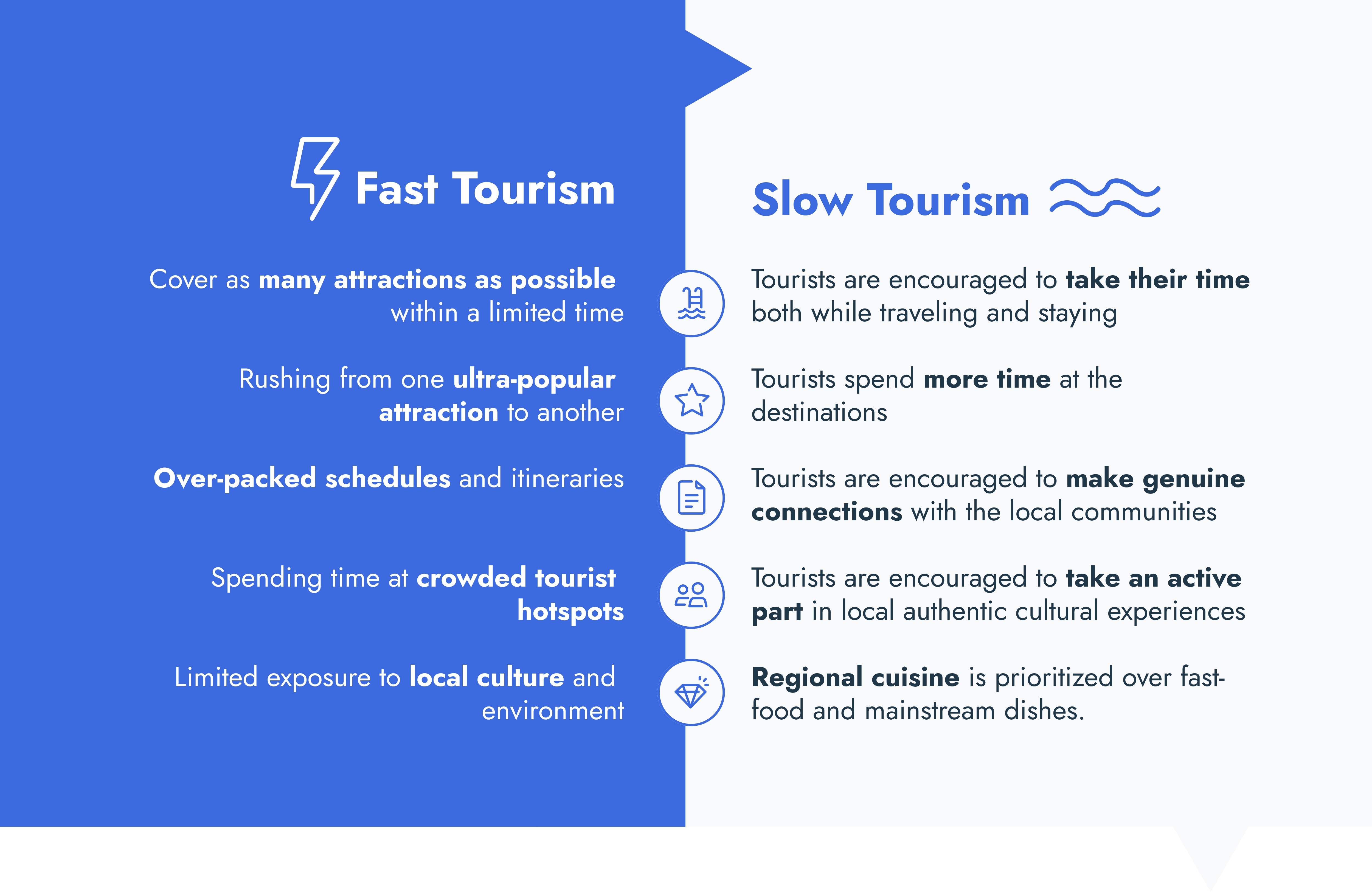
To compare, the following table synthesizes slow versus fast travel attributes from frameworks and studies:
| Aspect | Slow Travel | Fast Travel |
|---|---|---|
| Pace and Duration | Extended stays in fewer places; unhurried | Rapid transits; tight schedules |
| Transport | Trains, walking, cycling; low-emission | Flights, cars; high-emission |
| Economic Impact | 60% more local spending; SME support | Focused on operators; less community gain |
| Environmental Footprint | Up to 90% less CO₂; regenerative practices | 8% global GHGs; overtourism strain |
| Emotional Outcomes | Stress reduction (62%), mindfulness, connections | Fatigue, superficial joy |
| Cultural Engagement | Immersive, authentic | Checklists, performative |
| Learning Style | Organic, experiential | Guided, instructional |
Slow Tourism Case Studies: Examples to Truly Understand Slow Tourism – Mize
Another table on psychological benefits, drawn from expert insights:
| Benefit | Description | Supporting Evidence |
|---|---|---|
| Stress Reduction | Alleviates anxiety via leisurely pace | 62% report lower stress (Expedia Unpack ’25) |
| Mindfulness | Enhances presence and awareness | Organic noticing of details (Psychology Today) |
| Self-Confidence | Builds through social interactions | Personal transformations in novel settings |
| Rootedness | Fosters belonging in destinations | Deeper cultural connections |
| Reconnection | Improves bonds with loved ones | Nearly 50% note better relationships (Expedia) |
Slow Tourism Case Studies: Examples to Truly Understand Slow Tourism – Mize
Conceptual frameworks position slow travel in multilevel stages: individual mindfulness, community engagement, global eco-responsibility, addressing mass tourism gaps. While quantitative metrics lag, trends signal growth amid climate imperatives, with X discussions echoing anecdotes of reduced burnout and enriched bonds.
In essence, slow travel’s richest yields stem not from speed but arrival—in pauses letting places unfold, attuning travelers profoundly.





 Sure Media Magazine
Leave a comment