

As machines rival human intelligence, they reveal which parts of politics, economics, and society were built around our limits—and which can now be deliberately redesigned.
By CHARCHER MOGUCHE
Artificial intelligence is no longer just a tool we wield. It is becoming something more unsettling and more powerful: a mirror that reflects humanity back to itself, and a lever that allows us to reshape the systems we once believed were fixed. As AI systems write, reason, predict, and decide at scales beyond human capacity, they are forcing a reckoning. If intelligence is no longer uniquely human, what were our societies really built for—and what could they become?
For centuries, political institutions, economic models, and social norms evolved around human cognitive constraints: limited attention, slow information processing, and uneven expertise. AI destabilizes these assumptions. Its real significance lies not in automation alone, but in how it exposes the hidden architecture of civilization—revealing which systems exist to manage human limitation rather than to express human values. This shift opens a rare opportunity: to consciously redesign how we govern, organize, and live together.
When Intelligence Stops Being Exclusive
For most of history, intelligence has been treated as humanity’s defining trait—a scarce and fragile resource that justified hierarchies, institutions, and rituals of authority. To be human was to think, to reason, to imagine. Entire moral, legal, and political systems were quietly built on this assumption, embedding cognition into ideas of merit, leadership, and even worth.
Education systems sorted people by perceived mental capacity. Economic systems rewarded those whose thinking could be converted into productivity. Political systems elevated elites presumed to possess superior judgment. Intelligence was not just a capability; it was a moral credential.
AI disrupts that foundation. When machines can reason, compose, predict, and strategize, intelligence loses its exclusivity. What follows is not the end of human relevance, but the end of a comforting illusion: that cognition alone explains our social order. AI forces a separation we long avoided—between intelligence as computation and meaning as choice.
Machines can analyze the world with astonishing clarity. They can surface patterns no human could hold in mind, simulate futures no committee could debate, and optimize systems beyond intuitive grasp. What they cannot do is tell us what the world ought to be. That unresolved question—ethical, political, existential—is where philosophy returns to center stage.
Politics as Moral Design
Politics has often hidden behind procedure. Bureaucracy, delay, and ritual have served as proxies for legitimacy in a world where faster or better decisions were simply impossible. Slowness could be framed as caution; opacity as stability; compromise as wisdom.
AI removes that excuse. If policies can be modeled, stress-tested, and revised in near real time, then inefficiency is no longer a neutral fact—it becomes an ethical position. The central political question shifts from Can we know? to What do we value enough to act on?
This transformation exposes a deeper tension. Democratic systems were never only about outcomes; they were also about participation, trust, and consent. The challenge is not whether AI can improve governance, but whether societies can integrate intelligence without hollowing out legitimacy.
In this sense, AI does not replace politics—it intensifies it. Power can no longer disguise itself as ignorance. Responsibility can no longer be deferred to process. Every design choice becomes a moral claim about whose interests matter and whose risks are acceptable.
Economics After Scarcity Thinking
Modern economics rests on a quiet premise: scarcity is natural, and inequality is its unfortunate but inevitable companion. From this view, markets do not merely distribute resources; they ration them, deciding who gets what, when, and at what cost.
AI unsettles this story. When coordination, prediction, and optimization approach abundance, scarcity begins to look less like fate and more like design. Waste, inefficiency, and exclusion become increasingly difficult to justify as technical limitations.
The philosophical tension sharpens. If material sufficiency becomes technically achievable, then deprivation demands justification. Economic questions shift from How do we grow? to How do we distribute meaningfully? Value moves away from productivity alone and toward dignity, care, and long-term resilience.
In such a world, work can no longer be defended solely as a means of survival. It becomes a choice about purpose—something that can confer meaning, or strip it away. AI does not answer this question. It merely makes avoidance impossible.
Meaning in a World That Thinks Back
Perhaps the deepest disruption is cultural rather than economic or political. Creativity once signaled individuality; authorship implied presence; expression suggested experience. As machines generate art, language, music, and ideas, these signals blur.
This provokes anxiety, but it also offers clarity. If originality can be automated, then meaning cannot rest on output alone. It migrates inward—to intention, responsibility, and interpretation. What matters is not simply that something is created, but why, for whom, and with what consequences.
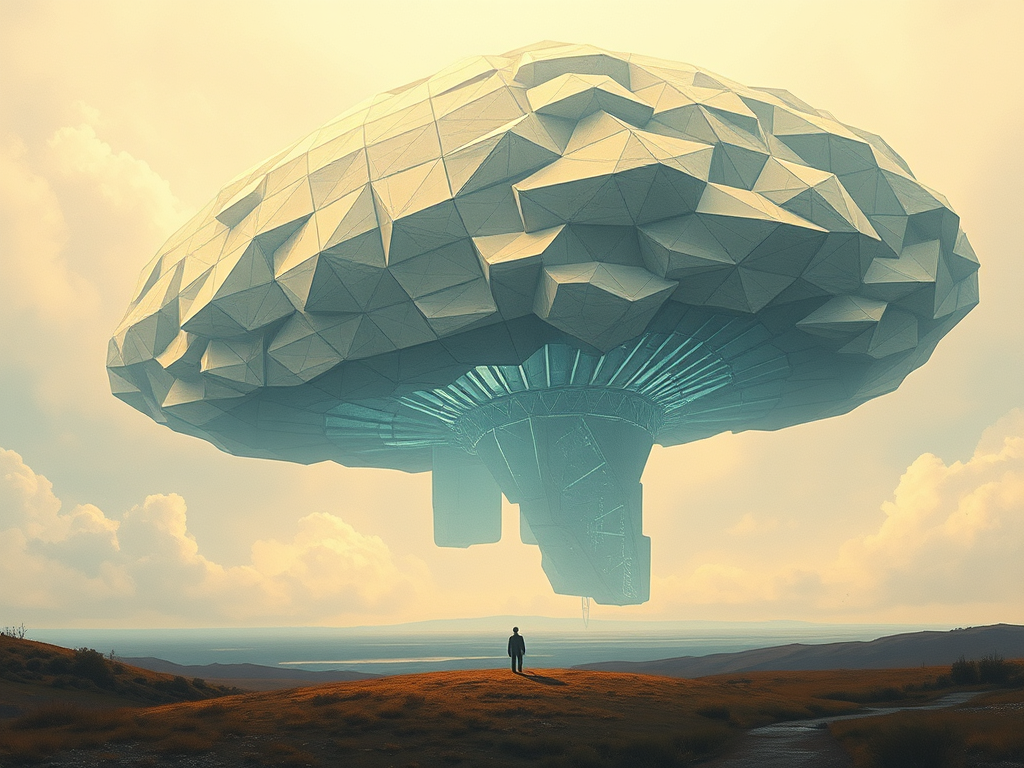
In this sense, AI does not hollow out humanity. It clarifies it. What remains distinct is not our ability to think, but our capacity to care, to choose, and to take responsibility for the worlds we create. Intelligence becomes widespread; meaning remains fragile—and therefore precious.
What AI Forces Us to Reconsider
- Intelligence: Is it a capacity to process information—or to choose values?
- Work: If productivity is automated, is employment still the primary basis for dignity?
- Governance: Should speed and accuracy replace ritual and delay?
- Equity: If abundance is possible, what justifies inequality?
Pull Quote:
“When intelligence is no longer uniquely human, the question is no longer what machines can do—but what kind of society we choose to become.”
AI’s greatest impact may not be what it does for us, but what it reveals about us. By stripping away the excuse of human limitation, it exposes the moral and political choices embedded in our systems. We can no longer claim that inefficiency, exclusion, or fragility are inevitable. They are decisions—often inherited, rarely questioned.
The age of artificial intelligence is not asking humanity to compete with machines. It is asking something far more demanding: to decide, without the cover of limitation, what kind of civilization it believes is worth sustaining. The mirror has been raised. The lever is within reach.





 Sure Media Magazine
Leave a comment