
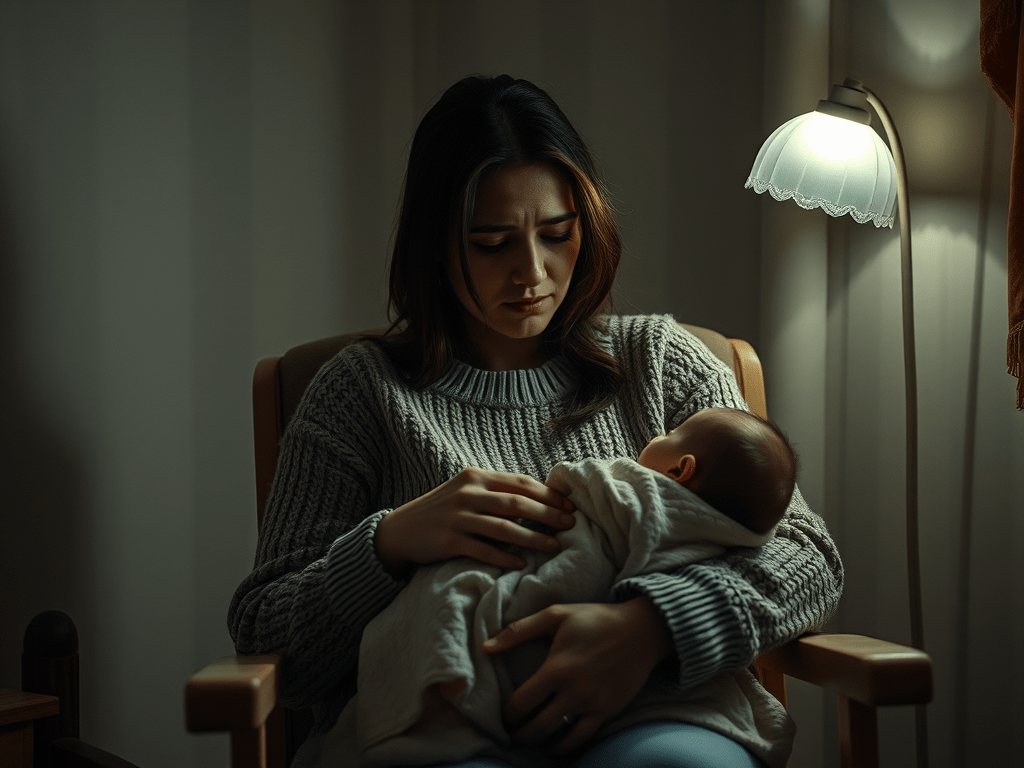
During my pregnancy, everyone kept telling me how strong I was. I carried that encouragement like armor. I prepared for childbirth the way people prepare for a marathon: breathing exercises, hospital bags packed early, spreadsheets of what the baby would need. I believed that if I could endure the pregnancy and survive delivery, the hardest part would be behind me, I was wrong.
When my baby finally arrived, I felt relief, joy, & exhaustion everything people say you will feel. The delivery was painful, but it was straightforward my baby was healthy. I was discharged with the standard after-care instructions: watch for fever, bleeding, & infection. No one mentioned the kind of pain that doesn’t show on your body.
In the first week at home, I assumed the tears, shaking, and panic were a normal part of adjustment. Everyone told me motherhood was overwhelming, but what I was feeling went far beyond being swept over. It was a quiet collapse, a heaviness I couldn’t explain, & a darkness that seemed to grow stronger each day.
I would wake up at night drenched in sweat, not because the baby was crying, but because my heart was racing. I was afraid to sleep and afraid to be awake sometimes I felt disconnected from everything including my own child. I would hold the baby in my arms but I felt nothing, no warmth & no connection, just a strange frightening emptiness.
I kept telling myself: you survived pregnancy, you survived childbirth, you can survive this too. I didn’t know surviving would become my full-time job.
During the day, I forced myself to function. I fed the baby, cleaned, & tried to respond to messages. On the outside, I looked like a tired new mother but on the inside, I was sinking. I felt trapped in my own mind, where thoughts spun out of control. What if something happens to the baby? What if I make a mistake? What if I’m not supposed to be a mother at all?
But the worst part wasn’t the intrusive thoughts it was the shame. Shame for not feeling the joy everyone talked about. Shame for wanting a break from a child I had prayed for. Shame for thinking I was failing before I even began.
In my community, mothers are expected to adjust, to be grateful, to carry their roles without question. Mental health is often dismissed as weakness or a spiritual issue. I knew that if I admitted I was drowning, some might say I was overreacting, or ungrateful, or simply tired so I stayed silent, that silence nearly broke me.
One day, after a long night of crying both me and my baby I found myself staring at the wall in total numbness. My body felt heavy, but not from lack of sleep. It felt heavy from hopelessness, the darkness had stopped creeping, it was fully inside me. That was the moment I knew something was deeply wrong.
I reached out to a close friend who had once hinted at her own struggles after childbirth. I didn’t tell her everything I just said, “I’m not okay.” she didn’t dismiss me, she didn’t tell me to pray harder or be strong, she simply said, “You might be going through postpartum depression. You need help.” That sentence became my turning point.
I didn’t feel fully ready, but I took the first step, I spoke to a healthcare provider & for the first time, someone asked me questions not just about breastfeeding or pain but about my emotions, sleep, appetite, and thoughts. When the provider said the words “postpartum depression,” I felt a strange mix of shame and relief. Shame because I still feared judgment & relief because there was finally a name for what I was experiencing, it wasn’t weakness, it wasn’t failure, it was an illness.
With guidance, I slowly began treatment and found a support system, It was not a fast recovery, and some days were harder than others, but naming my struggle made it possible to fight it. I learned that healing is not a straight line. It is a series of small, shaky steps toward yourself.
I also learned that postpartum depression does not care about how strong you are, how much you love your baby, or how well you prepared. It can arrive quietly, weeks or months after birth. It can look like sadness, anger, numbness, exhaustion, or total detachment and it can affect any mother, anywhere.
Today, I am still healing but I am no longer drowning in silence. I speak openly because I want other mothers to know that the darkness that arrives after childbirth is real, but it is not a life sentence, you are not broken, you are not a bad mother, & you are not alone.
I survived pregnancy, I survived childbirth and now, I am surviving this too, not by pretending to be strong, but by allowing myself to be human, vulnerable, and deserving of help.
If you are reading this and the darkness feels familiar, please know that reaching out is the bravest step you can take. Postpartum depression is not your fault, and healing is possible.




 Sure Media Magazine
Leave a comment