
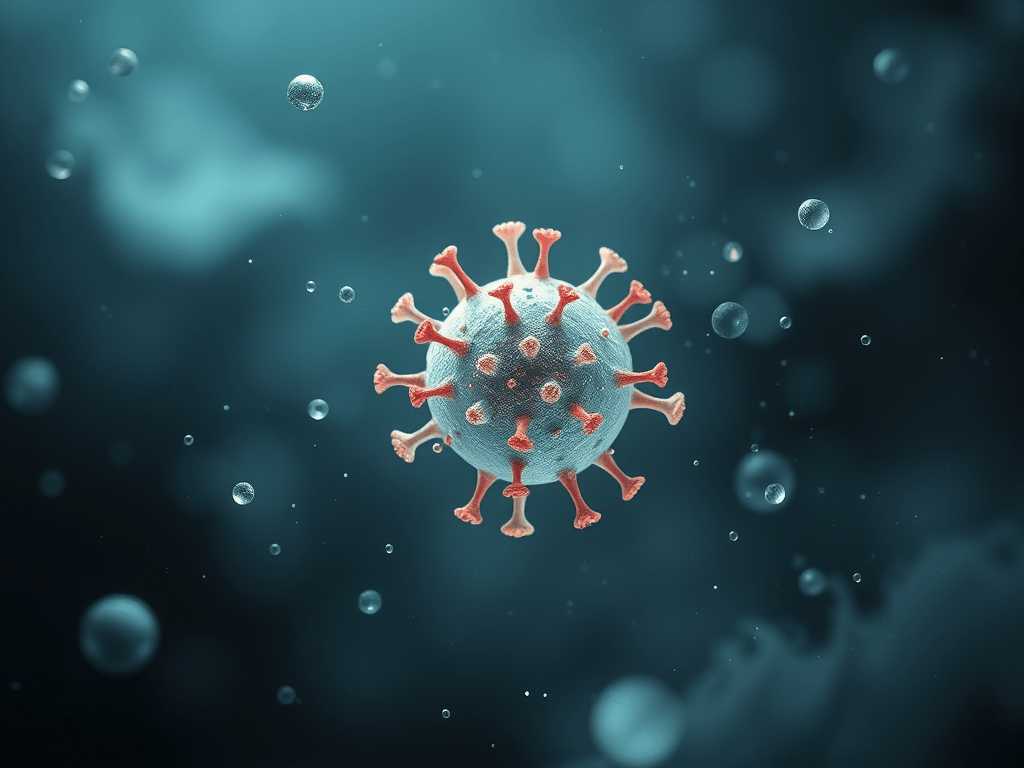
If you were to shrink yourself down to the size of a molecule and float into a droplet of breath from someone who just sneezed, you would find yourself in a crowded microscopic universe. Dust particles, water vapor, bits of skin, drifting pollen—and among them, scattered like tiny seeds waiting for the right soil, are viruses. Each one is stunningly small. A single grain of salt could hide millions of them.
But here’s the strangest part:
None of them are alive.
Not yet.
A virus is a creature that exists in a paradox—not living in the places where it waits, but suddenly bursting into life the moment it enters a cell. It is a biological ghost: inert, silent, and powerless alone, yet explosive with activity inside a living body.
This is the story of how something can be both dead and alive depending only on where it stands.
A Virus in the Air: A Particle Without Life
Picture one virus drifting alone in the air—a lone speck, lighter than the wind. It carries only a small package of genetic instructions, either DNA or RNA, wrapped in a protective coat.
Inside, the instructions might say something simple, like:
- “Copy me.”
- “Build more of my shell.”
- “Break out of the cell when finished.”
But floating in the air, these instructions are useless. A virus has no tools to read them. It has no machinery, no metabolism, no ability to sense or respond to anything around it.
If it were a factory, it would be a factory with no workers, no electricity, and no floor—just a blueprint rolled up on a desk.
That’s why scientists classify viruses as non-living particles when they are outside a host.
- They do not grow.
- They do not eat.
- They do not reproduce alone.
- They cannot maintain themselves.
- They cannot make energy.
They’re closer to seeds, or even USB drives—containers holding information, waiting for a machine to plug them in.
And so our lone virus drifts.
Life Begins at the Cell Membrane
After minutes or hours of drifting, it lands on something warm, soft, and alive—a cell lining someone’s throat or lungs. Suddenly, the world changes.
The virus’s outer shell fits into the cell’s surface like a key sliding into a lock. This matching is not magic—it’s chemistry: the shape of the virus proteins matches the shape of cell receptors.
Once the key fits, the lock opens.
The virus slips inside.
And the moment it does, everything changes.
Inside the cell, the virus encounters a fully equipped workshop:
- energy
- enzymes
- ribosomes (protein-making machines)
- materials for building new molecules
It now has the workforce and electricity it lacked.
It unrolls its genetic instructions.
It hijacks the cell’s machinery.
The factory turns on.
And suddenly—the virus is alive.
Not alive in the sense of growing, or eating, or moving, but alive in the only way it knows: by replicating itself.
This is the core of the virus paradox:
it is alive only when it is using someone else’s life.
Inside the Hijacked Cell: A Story of Takeover
Imagine a quiet printing shop owned by a cell.
All day long, the shop prints the cell’s own manuals—proteins that help it function, repair itself, communicate, and survive.
But when our virus enters, it barges into the office and slaps down a different set of blueprints.
“Print this instead.”
The printers obey.
They can’t tell the difference; they only know how to read genetic instructions.
Suddenly, the shop is not producing cell proteins anymore.
It is printing:
- virus shells
- virus enzymes
- virus genomes
The cell becomes a silent hostage, its own identity overwritten. The virus hasn’t just invaded; it has redirected the cell’s purpose.
This is why viruses feel so eerie. Most threats in nature—predators, bacteria, parasites—work by destroying or consuming. But a virus is subtler. It doesn’t eat the cell. It reprograms it. It turns life into a copy machine.
The cell slowly fills with viral parts, like a factory overflowing with identical toys.
And then comes the moment of escape.
Birth by Destruction
Every virus has its own exit strategy.
Some viruses, like influenza, trickle out of the cell gently, stealing pieces of the cell membrane as they go—like thieves sneaking through an unlocked door.
Others, like many bacteriophages (the viruses that infect bacteria), build up pressure until the cell bursts open, releasing thousands of viral copies at once.
This explosive birth is called lysis.
The cell dies to release new life.
It is, in a sense, reproduction.
But not reproduction driven by the virus’s own effort—reproduction powered entirely by the stolen machinery of the host.
Once released, the newborn viruses drift away. And the cycle begins again:
- outside the cell → not alive
- inside the cell → alive
- back outside → not alive
This flickering between states—alive in one place, inert in another—is what makes viruses so strange.
Are Viruses Living or Nonliving? Science Says… Both?
Biologists disagree, and here’s why.
Arguments that viruses are NOT alive:
- They don’t breathe.
- They don’t grow or maintain themselves.
- They can’t reproduce alone.
- They have no metabolism.
- They are inert and inactive outside cells.
This makes them more like chemicals than creatures.
Arguments that viruses ARE alive:
- They evolve (faster than any living organism).
- They adapt and mutate in response to pressures.
- They reproduce inside cells.
- They use genetic information just like living organisms.
- They form ecological relationships with hosts.
This makes them unmistakably biological.
So scientists compromise:
viruses exist on the edge of life—neither fully in nor fully out.
They are life’s shadow.
Life’s echo.
Life’s reflection in a world too small to see.
A Bigger Mystery: Where Did Viruses Come From?
If viruses are not quite alive, where did they originate?
There are three main theories.
1. The Escape Hypothesis
Viruses may have started as fragments of DNA or RNA that “escaped” cells, becoming free-floating genetic parasites.
2. The Reduction Hypothesis
Viruses might be descendants of ancient cells that lost most of their machinery over time, shrinking down into tiny packets of genes.
3. The Virus-First Hypothesis
Viruses could predate cellular life itself—primordial genetic shards from a time before cells existed.
Each theory fits some evidence, but none solves the entire mystery.
Viruses remain older than our understanding of life, woven into evolution’s deepest past.
Viruses Are Everywhere—and Have Shaped Everything
Every ocean, every forest, every patch of soil, every mouthful of air contains viruses. One teaspoon of seawater can contain 50 million.
But here’s the twist most people never hear:
Viruses helped build the world we live in.
They’ve shaped evolution, influenced immunity, and even contributed genes to mammals. A chunk of human DNA—nearly 8%—comes from ancient viruses that infected our ancestors.
They have:
- controlled bacterial populations
- steered oceanic ecosystems
- influenced the development of placental mammals
- inspired tools in modern biotechnology
One virus, millions of years ago, inserted genes that eventually helped mammals form placentas—meaning without viruses, human birth might not exist.
Viruses are not just destroyers.
They are participants in the story of life.
Why the Alive-or-Not Question Matters
You might wonder: does it really matter if a virus is alive?
It does—because defining “life” shapes how we fight viruses.
If viruses were alive like bacteria, antibiotics might work.
But antibiotics target bacterial machinery—machinery viruses do not have.
To treat viruses, we must understand their unique in-between status:
- inert outside → vulnerable
- active inside → hijacking
That’s why antiviral drugs often work by:
- blocking entry
- stopping replication
- interfering with assembly
- preventing exit
We’re not killing a living organism.
We’re sabotaging a process.
The Cell’s Perspective: Life Under Siege
Imagine being the cell. One moment, everything is normal. The next, an invader rewrites your identity.
Viruses don’t think. They don’t plan.
But their behavior is startlingly close to strategy.
Cells respond with their own defenses:
- shutting down internal machinery
- raising chemical alarms
- sacrificing themselves to stop viral spread
This microscopic warfare—cell against virus—is one of the oldest battles in biology. It has been going on for billions of years, long before humans existed.
Your immune system is the evolved result of that ancient struggle.
The Final Paradox: Life Built From Nonlife
Maybe the reason viruses feel so strange is because they expose a fundamental tension at the heart of biology:
Life is not a switch. It is a spectrum.
A virus blurs the lines between chemistry and creature. It doesn’t fit our categories. It forces us to reconsider what “alive” really means.
If something can:
- evolve
- adapt
- replicate
- interact with ecosystems
…without being alive all the time, then life is not a simple state. It’s a process that turns on and off depending on context.
A virus is alive only when it borrows the life of something else.
It is a spark that ignites only in the right fuel.
Outside a cell, it is a stone.
Inside a cell, it is fire.
The Takeaway
A virus is neither alive nor dead. It is something stranger:
a blueprint that becomes a being, a particle that becomes a process, a chemical that becomes a creature.
It floats through the world inert and silent, waiting for the moment it touches life—and then it becomes life’s most efficient imitator.
Understanding this dual nature doesn’t just help us fight disease. It helps us see the biological world more clearly, revealing that life is not a fixed boundary but a shifting frontier.





 Sure Media Magazine
Leave a comment