
Introduction
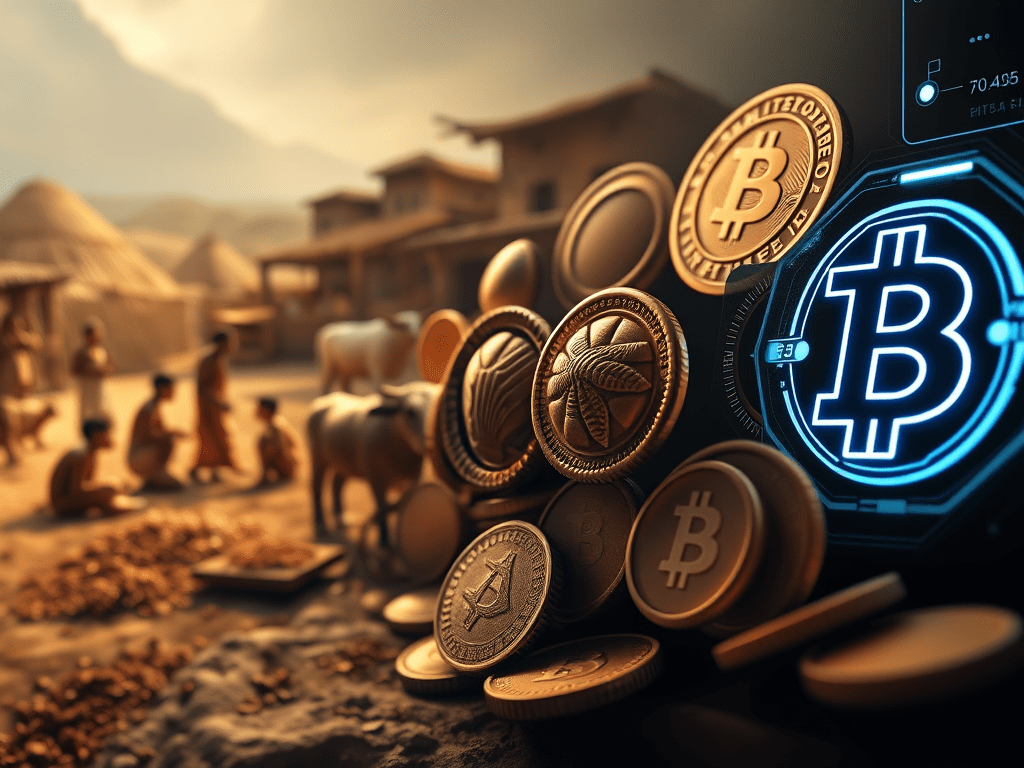
Money is more than just paper bills and coins in our pockets—it’s a fundamental pillar of human civilization, enabling trade, economic growth, and societal progress. From its humble beginnings in primitive barter systems to the cutting-edge world of cryptocurrencies like Bitcoin, the story of money is one of innovation, adaptation, and sometimes controversy. As we stand in 2025, with digital currencies gaining mainstream traction and central banks exploring their own versions, understanding this evolution helps us grasp how money shapes our world. This article traces the journey of money, highlighting key milestones, the forces driving change, and what the future might hold, drawing on historical insights and recent developments.
The Barter System: The Dawn of Exchange
Long before formalized currency, humans relied on barter—the direct exchange of goods and services without a medium. Dating back to around 6000 BCE in ancient Mesopotamia, people traded items like cattle, grains, or tools based on mutual needs. For instance, a farmer might swap wheat for a potter’s clay vessels. This system worked in small, self-sufficient communities where trust was high and needs aligned.
However, barter had inherent limitations. It required a “double coincidence of wants”—both parties had to desire what the other offered simultaneously. Perishable goods posed storage issues, and valuing disparate items (e.g., how many chickens for a cow?) led to inefficiencies. These challenges spurred the search for a more reliable medium of exchange, setting the stage for money’s evolution.
Commodity Money: Valuing the Tangible
To overcome barter’s flaws, societies turned to commodity money—items with intrinsic value that were widely accepted. Around 3000 BCE, items like cowrie shells in China, salt in the Roman Empire (from which “salary” derives), and cacao beans in Mesoamerica served as currency. These were durable, divisible, and portable, making trade smoother.
Precious metals like gold and silver emerged as superior commodities due to their scarcity, malleability, and universal appeal. By 2000 BCE, Mesopotamians used silver ingots, while ancient Egyptians weighed gold rings for transactions. This shift marked money’s transition from mere utility to a store of value, facilitating larger-scale commerce and early economies.
Coinage: Standardizing Value
The invention of coined money around 600 BCE in Lydia (modern-day Turkey) revolutionized trade. King Croesus minted the first standardized gold and silver coins, stamped with royal seals to guarantee purity and weight. This innovation eliminated the need for weighing metals each time, reducing fraud and boosting confidence.
Coins spread rapidly: The Persians adopted them, followed by the Greeks and Romans, who used them to fund empires and wars. In China, around 1000 BCE, bronze coins shaped like knives or spades were in use, evolving into round coins with holes for stringing. Coinage enabled taxation, salaries, and international trade, laying the groundwork for modern financial systems.
Paper Money and the Rise of Banking
Paper money originated in China during the Tang Dynasty (7th century CE), initially as promissory notes for merchants to avoid carrying heavy coins. By the Song Dynasty (11th century), the government issued Jiaozi notes backed by reserves, marking the first widespread fiat-like currency.
In Europe, paper money gained traction in the 17th century with the establishment of banks like the Bank of England in 1694, which issued notes redeemable for gold. The gold standard, where currency was pegged to gold, provided stability until the 20th century. Banking evolved alongside, with institutions safeguarding deposits and lending, fueling the Industrial Revolution.
Fiat Currency: Trust in Governments
The 20th century saw the shift to fiat money—currency without intrinsic value, backed solely by government decree. The U.S. abandoned the gold standard in 1971 under President Nixon, allowing the dollar to float freely. Today, most global currencies, like the euro and yen, are fiat, deriving value from trust in issuing authorities and economic stability.
Fiat enabled flexible monetary policies, such as printing money during crises, but it also introduced risks like inflation and hyperinflation, as seen in Zimbabwe or Venezuela. Central banks now manage supply through interest rates and quantitative easing to maintain balance.
Digital Money: Cards, Apps, and E-Wallets
The late 20th century digitized money with credit cards (introduced in the 1950s) and electronic transfers. ATMs in the 1960s and online banking in the 1990s made transactions seamless. Mobile payment apps like Venmo and Alipay, along with contactless cards, have further accelerated this trend.
In 2025, digital money dominates: Over 80% of transactions in developed countries are cashless, driven by convenience and security features like biometrics. Central Bank Digital Currencies (CBDCs), like China’s digital yuan, blend fiat with blockchain for traceable, efficient systems.
Cryptocurrencies: Decentralized Revolution
The 2008 financial crisis inspired Satoshi Nakamoto’s Bitcoin whitepaper, introducing cryptocurrency in 2009—a decentralized digital currency using blockchain for secure, peer-to-peer transactions without intermediaries. Blockchain, a distributed ledger, ensures transparency and immutability.
By 2025, cryptocurrencies like Bitcoin (valued over $100,000 per coin) and Ethereum have market caps in the trillions, with uses in remittances, NFTs, and DeFi (decentralized finance). However, volatility, regulatory hurdles, and environmental concerns (e.g., energy-intensive mining) persist. Innovations like stablecoins and layer-2 solutions aim to address these.
Challenges and Future Prospects
Money’s evolution isn’t without pitfalls. Inequality arises when access to financial tools is uneven, and cyber threats target digital systems. Cryptocurrencies challenge traditional finance, prompting regulations like the EU’s MiCA framework.
Looking ahead, money may become fully programmable via smart contracts, integrating with AI for personalized economies. Quantum computing could disrupt encryption, while sustainable mining pushes green crypto. Virtual currencies in metaverses, like Linden Dollars, hint at parallel economies.
Conclusion
From barter’s simplicity to cryptocurrency’s complexity, money has mirrored human progress, adapting to needs for efficiency, security, and inclusivity. As we embrace digital frontiers, the core principles—trust, value, and exchange—remain timeless. Understanding this evolution equips us to navigate future changes, whether investing in Bitcoin or advocating for equitable systems. In a world where money is increasingly abstract, its impact on our lives is profoundly real.





 Sure Media Magazine
Leave a comment