
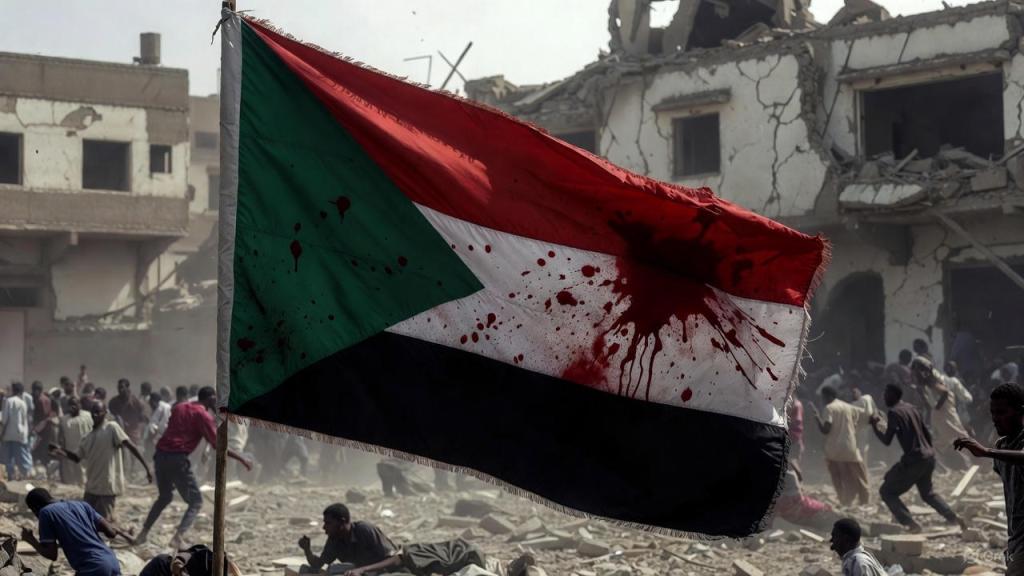
As December 2025 unfolds, Sudan remains trapped in one of the most devastating civil wars of the 21st century, a conflict that has claimed tens of thousands of lives and displaced millions since erupting in April 2023. What started as a power struggle between the Sudanese Armed Forces (SAF), led by General Abdel Fattah al-Burhan, and the Rapid Support Forces (RSF), commanded by Mohamed Hamdan Dagalo (known as Hemedti), has spiraled into a humanitarian nightmare. With famine gripping parts of the country, reports of mass atrocities—including people being forced to dig their own graves and buried alive—and a staggering death toll, Sudan’s crisis is often dubbed the “forgotten war.” Despite urgent pleas from aid workers and survivors, international attention remains scant, overshadowed by other global conflicts.
The war has ravaged cities like Khartoum, Darfur’s El-Fasher, and central regions like Kordofan, turning once-vibrant communities into ghost towns of rubble and despair. Over 10 million people have been displaced internally, with another 2 million fleeing to neighboring countries like Chad and Egypt. Aid organizations warn that without immediate intervention, the death toll—already estimated at over 150,000 from violence, disease, and starvation—could skyrocket.
The Escalating Battlefield: From Siege to Conquest
The conflict’s latest flashpoint has been El-Fasher, the last major SAF stronghold in Darfur, which fell to the RSF in late October 2025 after a brutal siege lasting over a year. RSF forces, accused of receiving support from the United Arab Emirates, encircled the city, cutting off supply lines and bombarding civilian areas indiscriminately. Witnesses described relentless artillery fire and drone strikes that leveled hospitals and markets, forcing residents to huddle in makeshift shelters amid constant fear.
In the days leading to the city’s capture, RSF fighters stormed neighborhoods, executing civilians in what UN human rights chief Volker Türk called “appalling reports of summary executions and other serious violations.” Arab nations condemned the killings, labeling them a “true genocide,” with at least 1,500 people slaughtered in a matter of days. The RSF has denied systematic atrocities, claiming operations target only military threats, but evidence from survivors and satellite imagery tells a different story: mass graves, burned villages, and a pattern of ethnic targeting against non-Arab communities in Darfur.
Further east, in central Sudan, intensified fighting in Kordofan has displaced thousands more, with RSF advances clashing against SAF positions. Both sides have been accused of using starvation as a weapon, blocking aid convoys and looting warehouses, exacerbating the crisis in isolated regions.
A Famine of Epic Proportions: No Food, No Hope
Sudan’s humanitarian disaster is perhaps the most acute aspect of the war, with famine officially declared in El-Fasher and Kadugli by November 2025. Over 21.2 million people—nearly half the population—are facing acute hunger, with millions in IPC Phase 4 (emergency) or Phase 5 (famine) conditions. In camps like Zamzam and Abu Shouk, families survive on meager rations of wild leaves and insects, their children reduced to “skin and bones,” as one aid worker put it.
Personal stories from the ground are heart-wrenching. A doctor in El-Fasher described treating malnourished infants whose mothers had nothing left to give: “We see children dying daily from hunger, their bodies too weak to fight infections.” In the Nuba Mountains, families trek miles for water, only to return to empty pots. One mother in a Telegraph report recounted watching her toddler waste away: “He cries for food, but there’s nothing. The war has taken everything.” The RSF’s siege tactics have blocked over 70% of aid deliveries, leaving warehouses full while people starve outside.
Malnutrition has claimed over 730,000 children, with 14 million more in dire need of aid. Hospitals, where 70-80% are non-functional, overflow with cases of severe acute malnutrition, compounded by outbreaks of cholera and measles. “This is not just a famine; it’s engineered starvation,” said a UN official, pointing to deliberate blockades by both factions.
Atrocities Beyond Imagination: Buried Alive and Worse
The war’s brutality knows no bounds, with reports of civilians being buried alive emerging as a chilling hallmark of RSF tactics. In El-Fasher, videos circulated showing fighters forcing men to dig their own graves before executing them on camera—a grim spectacle that has shocked even hardened observers. One survivor from Zamzam camp recalled: “They came at night, rounded up the men, made them kneel in the dirt. Some were buried while still breathing, screaming for mercy.”
Rape has been weaponized on a massive scale, with hundreds of women and girls reporting assaults by soldiers from both sides, sparking mass migrations to escape the terror. In one account, a young woman from Darfur fled after repeated attacks: “I have to talk about it so the world knows what happened to us.” Mass killings at hospitals, like the one in El-Fasher where patients were dismembered or burned alive, have drawn comparisons to historical genocides. The UN has greenlit investigations into these war crimes, but perpetrators remain at large, fueling a cycle of impunity.
From the RSF’s perspective, these actions are framed as necessary to combat SAF “extremists,” but critics, including Sudanese activists, accuse them of ethnic cleansing in Darfur. SAF forces, meanwhile, have been implicated in indiscriminate bombings and arbitrary detentions.
International Indifference: Calls for Action Fall on Deaf Ears
The world’s response has been criticized as inadequate. The UN has decried the “failure” to act, with peace talks in Geneva stalling over cease-fire demands. Aid groups like the World Food Programme have expanded access in some areas, but restrictions persist, and funding is woefully short—only 40% of the $2.7 billion appeal met. Activists call for airdrops in besieged areas like El-Fasher, where over half a million starve under siege.
Regional players complicate matters: The UAE is accused of arming the RSF, while Egypt backs the SAF. Social media echoes frustration, with users lamenting racial bias in global attention: “The world turns a blind eye to those with darker skin.” One Sudanese journalist wrote: “The war on civilians continues unabated… If bombs don’t kill you, hunger will.”
An Uncertain Horizon: Resilience Amid Ruin
Sudan’s people endure with remarkable resilience, but the toll is immense. The economy has collapsed, with inflation soaring and markets destroyed. Without a genuine ceasefire and unimpeded aid, experts warn of millions more deaths in 2026. As one survivor put it: “We ask only for the world to see us, to help us live.” The question remains: Will the international community finally listen, or will Sudan’s tragedy fade further into oblivion?### Sudan’s Silent Genocide: Famine, Atrocities, and a World That Looks Away
As December 2025 unfolds, Sudan remains trapped in one of the most devastating civil wars of the 21st century, a conflict that has claimed tens of thousands of lives and displaced millions since erupting in April 2023. What started as a power struggle between the Sudanese Armed Forces (SAF), led by General Abdel Fattah al-Burhan, and the Rapid Support Forces (RSF), commanded by Mohamed Hamdan Dagalo (known as Hemedti), has spiraled into a humanitarian nightmare. With famine gripping parts of the country, reports of mass atrocities—including people being forced to dig their own graves and buried alive—and a staggering death toll, Sudan’s crisis is often dubbed the “forgotten war.” Despite urgent pleas from aid workers and survivors, international attention remains scant, overshadowed by other global conflicts.
The war has ravaged cities like Khartoum, Darfur’s El-Fasher, and central regions like Kordofan, turning once-vibrant communities into ghost towns of rubble and despair. Over 10 million people have been displaced internally, with another 2 million fleeing to neighboring countries like Chad and Egypt. Aid organizations warn that without immediate intervention, the death toll—already estimated at over 150,000 from violence, disease, and starvation—could skyrocket.
The Escalating Battlefield: From Siege to Conquest
The conflict’s latest flashpoint has been El-Fasher, the last major SAF stronghold in Darfur, which fell to the RSF in late October 2025 after a brutal siege lasting over a year. RSF forces, accused of receiving support from the United Arab Emirates, encircled the city, cutting off supply lines and bombarding civilian areas indiscriminately. Witnesses described relentless artillery fire and drone strikes that leveled hospitals and markets, forcing residents to huddle in makeshift shelters amid constant fear.
In the days leading to the city’s capture, RSF fighters stormed neighborhoods, executing civilians in what UN human rights chief Volker Türk called “appalling reports of summary executions and other serious violations.” Arab nations condemned the killings, labeling them a “true genocide,” with at least 1,500 people slaughtered in a matter of days. The RSF has denied systematic atrocities, claiming operations target only military threats, but evidence from survivors and satellite imagery tells a different story: mass graves, burned villages, and a pattern of ethnic targeting against non-Arab communities in Darfur.
Further east, in central Sudan, intensified fighting in Kordofan has displaced thousands more, with RSF advances clashing against SAF positions. Both sides have been accused of using starvation as a weapon, blocking aid convoys and looting warehouses, exacerbating the crisis in isolated regions.
A Famine of Epic Proportions: No Food, No Hope
Sudan’s humanitarian disaster is perhaps the most acute aspect of the war, with famine officially declared in El-Fasher and Kadugli by November 2025. Over 21.2 million people—nearly half the population—are facing acute hunger, with millions in IPC Phase 4 (emergency) or Phase 5 (famine) conditions. In camps like Zamzam and Abu Shouk, families survive on meager rations of wild leaves and insects, their children reduced to “skin and bones,” as one aid worker put it.
Personal stories from the ground are heart-wrenching. A doctor in El-Fasher described treating malnourished infants whose mothers had nothing left to give: “We see children dying daily from hunger, their bodies too weak to fight infections.” In the Nuba Mountains, families trek miles for water, only to return to empty pots. One mother in a Telegraph report recounted watching her toddler waste away: “He cries for food, but there’s nothing. The war has taken everything.” The RSF’s siege tactics have blocked over 70% of aid deliveries, leaving warehouses full while people starve outside.
Malnutrition has claimed over 730,000 children, with 14 million more in dire need of aid. Hospitals, where 70-80% are non-functional, overflow with cases of severe acute malnutrition, compounded by outbreaks of cholera and measles. “This is not just a famine; it’s engineered starvation,” said a UN official, pointing to deliberate blockades by both factions.
Atrocities Beyond Imagination: Buried Alive and Worse
The war’s brutality knows no bounds, with reports of civilians being buried alive emerging as a chilling hallmark of RSF tactics. In El-Fasher, videos circulated showing fighters forcing men to dig their own graves before executing them on camera—a grim spectacle that has shocked even hardened observers. One survivor from Zamzam camp recalled: “They came at night, rounded up the men, made them kneel in the dirt. Some were buried while still breathing, screaming for mercy.”
Rape has been weaponized on a massive scale, with hundreds of women and girls reporting assaults by soldiers from both sides, sparking mass migrations to escape the terror. In one account, a young woman from Darfur fled after repeated attacks: “I have to talk about it so the world knows what happened to us.” Mass killings at hospitals, like the one in El-Fasher where patients were dismembered or burned alive, have drawn comparisons to historical genocides. The UN has greenlit investigations into these war crimes, but perpetrators remain at large, fueling a cycle of impunity.
From the RSF’s perspective, these actions are framed as necessary to combat SAF “extremists,” but critics, including Sudanese activists, accuse them of ethnic cleansing in Darfur. SAF forces, meanwhile, have been implicated in indiscriminate bombings and arbitrary detentions.
International Indifference: Calls for Action Fall on Deaf Ears
The world’s response has been criticized as inadequate. The UN has decried the “failure” to act, with peace talks in Geneva stalling over cease-fire demands. Aid groups like the World Food Programme have expanded access in some areas, but restrictions persist, and funding is woefully short—only 40% of the $2.7 billion appeal met. Activists call for airdrops in besieged areas like El-Fasher, where over half a million starve under siege.
Regional players complicate matters: The UAE is accused of arming the RSF, while Egypt backs the SAF. Social media echoes frustration, with users lamenting racial bias in global attention: “The world turns a blind eye to those with darker skin.” One Sudanese journalist wrote: “The war on civilians continues unabated… If bombs don’t kill you, hunger will.”
An Uncertain Horizon: Resilience Amid Ruin
Sudan’s people endure with remarkable resilience, but the toll is immense. The economy has collapsed, with inflation soaring and markets destroyed. Without a genuine ceasefire and unimpeded aid, experts warn of millions more deaths in 2026. As one survivor put it: “We ask only for the world to see us, to help us live.” The question remains: Will the international community finally listen, or will Sudan’s tragedy fade further into oblivion?





 Sure Media Magazine
Leave a comment