
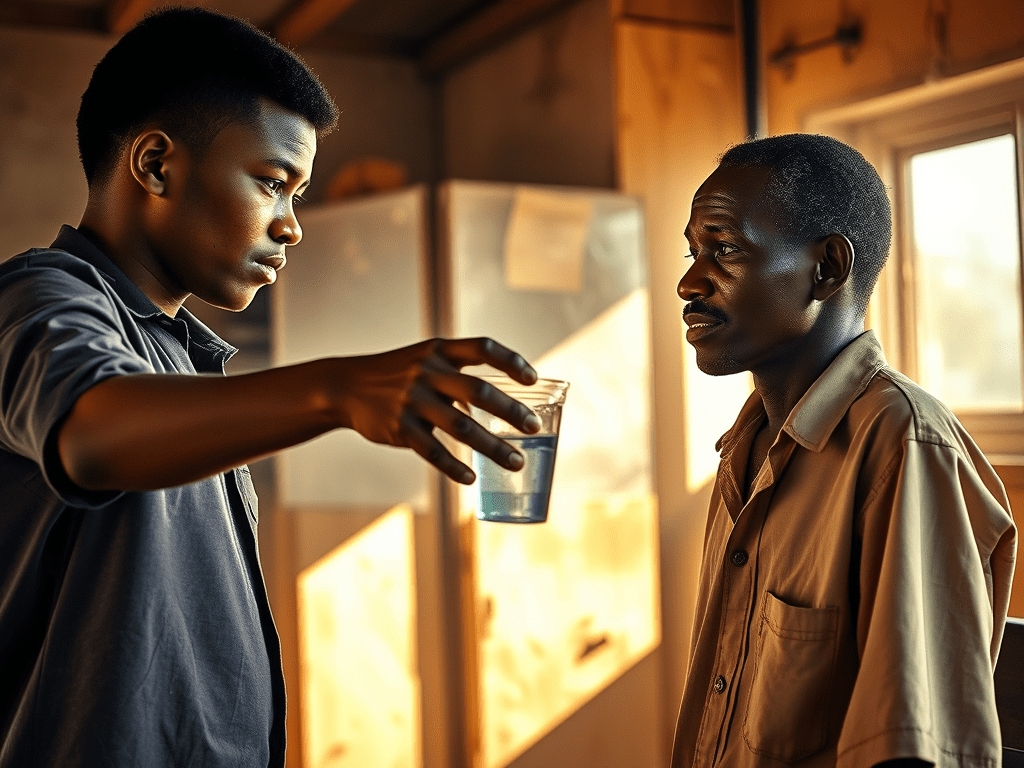
People talk about miracles, fate, and the mysterious forces of the universe that sometimes intervene in our daily struggles. But let me confidently state that none of those forces have the same impact as one humble cup of water served on a hot Nairobi afternoon twenty years ago. Yes, water. Not a donation, not a scholarship, not political connections. Just water in a plastic cup that probably cost five shillings at the time. Yet somehow, it became the most profitable investment of my life.
This is the story of how one act of kindness completed a twenty–year marathon and crossed the finish line in the CEO’s office at Kenyatta National Hospital (KNH).
The Day It All Began
Two decades ago, Nairobi was hot enough to toast bread on the pavement. I was young, hopeful, and extremely broke. If hopes and dreams were currency, I would have been a billionaire. But financially speaking, I was more liquid than solid; everything I had was metaphorical, except the cup of water I was about to hand a stranger.
I was working a casual job in a dusty office somewhere near the city center. As I rearranged papers and wondered if lunch that day would be spiritual or physical, a man walked in. He looked exhausted in a way that only Nairobi heat can exhaust a person. His shirt was clinging to him like it owed him loyalty.
He smiled politely and asked, “Nisaidie na maji tafadhali?”
There are requests you ignore, and there are requests your conscience refuses to let pass. So I handed him a cup of cold water. Not lukewarm tap water. No. This was elite-level cold water, the kind that shocks the throat and resets your soul. He drank it with the gratitude of someone who had been negotiating with dehydration.
“Thank you,” he said, genuinely.
And then he left. No dramatic exit, no heavenly choir, no slow motion. Just a man refreshed and on his way.
I never thought about him again. Life continued. Bills continued. Nairobi continued.
Fast Forward: The Hospital Chapter
Twenty years is a long time. In two decades, Nairobi had grown taller buildings, more matatus with questionable art, and inflation that deserved its own flag. I had grown older, wiser, and unfortunately, recently injured.
A medical emergency landed me at Kenyatta National Hospital, where the doctors did their best and stitched me back together. I was grateful to be alive until I saw the bill. The amount looked like a Safaricom customer care line: long, intimidating, and stressful.
As I stood at the billing office rehearsing my negotiation strategy, the billing officer said something that nearly made me forget my pain.
“The CEO would like to see you.”
I instantly wondered if I had mistakenly entered the wing meant for MPs. Why would a CEO want to see me?
Did I sleepwalk into the boardroom?
Did I accidentally unplug hospital equipment?
Or worse, was I about to be told there was a second bill that the first one was just a preview of?
The CEO’s Office: The Plot Twist
I walked into the CEO’s office cautiously, as if the carpet might charge me additional fees. The man behind the desk looked familiar in the same way a childhood cartoon looks familiar when you rewatch it as an adult.
He smiled warmly.
“Do you remember me?”
Those are the most dangerous five words in the English language.
I tried to dig through my memory archives. Nothing surfaced.
“I’m afraid I don’t,” I admitted.
He leaned back slightly. “Twenty years ago, I walked into a small office in town, very thirsty. You gave me a cup of water.”
My mental hard drive rebooted instantly.
The hot day.
The thirsty man.
The cold water.
“It was YOU?” I almost shouted.
He nodded. “I never forgot that kindness. It was a simple gesture, but at that moment, it meant more than you knew. When I saw your name on the patient list, I recognized it. Your bill is settled.”
Paid.
Cleared.
Removed from existence.
I stared at him, waiting for a hidden camera crew to jump out. This felt like something that should be on a reality show. My brain was still trying to process the math:
One cup of water = Entire surgical bill at KNH.
Return on investment: infinite.
I thanked him repeatedly, but he dismissed it with a smile. “Kindness has a long memory,” he said.
Why This Story Matters
We live in a world where people throw around the phrase “be kind” like confetti. But this experience redefined kindness for me. It taught me that every small gesture deposits something into the world. The deposit might not return tomorrow, next week, or even in the same decade. But the world remembers.
Social psychologists argue that small acts of prosocial behavior have ripple effects that extend far beyond the moment.
According to Penner, Dovidio, Piliavin, and Schroeder (2005), kindness activates a reciprocal process in human behavior that can manifest years later in unexpected ways.
Similarly, Grant and Patil (2020) highlight that seemingly small gestures often become the foundation of long-term goodwill, even when forgotten by the giver.
I was living proof.
The Larger Kenyan Context
If you grew up in Kenya, you know that water has stories. From offering water to visitors (because hospitality is our unofficial national policy), to sharing water in rural villages, to the survival-based generosity formed in urban neighborhoods, water is never just water.
In fact, in many African cultures, water symbolizes life, blessing, and peace. You cannot realistically turn down someone asking for it. And apparently, in rare but beautiful cases, water also symbolizes future financial relief.
Lessons I Walked Away With
- Kindness is a long-term investment.
You may forget the act, but the world doesn’t. - People remember how you made them feel.
Sometimes they remember long enough to cancel your surgical bill. - Never underestimate small actions.
Grand gestures are memorable. Small gestures are powerful. - Life has an excellent sense of humor.
Who knew hydration could be a financial strategy? - Your past self is constantly negotiating deals you’ll only understand in the future.
Mine negotiated a very successful one.
Conclusion
I walked into Kenyatta National Hospital worried about how to settle a bill. I walked out with a life lesson that was worth far more than the surgery. A cup of water I gave twenty years earlier returned to me in the most unexpected boardroom in Kenya.
If someone ever tells you that kindness is wasted, tell them this story.
And tell them to keep a jug of water nearby. You never know.
References
Grant, A., & Patil, S. (2020). What we know about the psychology of kindness in organizations. Organizational Psychology Review.
Penner, L. A., Dovidio, J. F., Piliavin, J. A., & Schroeder, D. A. (2005). Prosocial behavior: Multilevel perspectives. Annual Review of Psychology.




 Sure Media Magazine
Leave a comment