

For as long as courts have existed, judges have cultivated the image of the dispassionate arbiter: sober, restrained, above politics. The robe signals a kind of constitutional priesthood—an institution that rises above the ideological battles consuming the rest of the political system. But in the United States today, the rhetoric of neutrality functions less as a guiding principle and more as a weapon. It creates cover for a judiciary aggressively reshaping public life along deeply ideological lines.
The myth of neutrality doesn’t merely distort public understanding of what courts do. It reorganizes power. It allows judges to advance sweeping political outcomes while insisting they are doing nothing more than applying “the law.” This sleight of hand—this insistence that ideology belongs everywhere except on the bench—has become one of the most consequential political forces in modern American life.
Neutrality as Performance—Not Principle

Judicial neutrality sounds noble. In practice, neutrality is often defined by the ideological preferences of those who use the term the loudest. When a judge embraces a long-discredited historical narrative, or interprets constitutional silence as permission to upend decades of settled rights, the public is encouraged to see these as reflections of “discipline” and “fidelity to text.” When judges uphold government power over vulnerable people—detained immigrants, criminal defendants, pregnant women—they are praised for showing restraint.
Yet when a court rules in favor of expanding voting rights, enforcing anti-discrimination laws, or limiting police power, the same commentators and politicians decry “activist judges.”
The double standard reveals the truth: neutrality is political. It is an ideology wrapped in legal language.
How Neutrality Becomes a Mask for Ideological Warfare

In the last decade, major decisions have profoundly reshaped American society—on reproductive rights, democracy, economic regulation, labor power, and more. These rulings are not neutral. They are not inevitable outcomes of a fixed constitutional blueprint. They are political choices, rationalized after the fact by selective appeals to history, originalism, and textualism.
Consider the selective historical analysis deployed to eliminate the constitutional right to abortion. Or the creative reimagining of the Second Amendment that invalidated gun regulations long understood as constitutional. Or the resurrection of doctrines—like the major questions doctrine or nondelegation theory—once considered fringe ideas.
These outcomes were not accidents. They were results of a long-running ideological project.
Neutrality language plays a vital role in this project. It allows judges to consolidate power while framing dissent as emotional, political, or irrational. It transforms structural inequality into an unavoidable legal outcome. It suggests that constitutional interpretation is a purely mechanical exercise, not a choice with profound life-or-death consequences.
The Power of Pretending the Court Is Above Politics
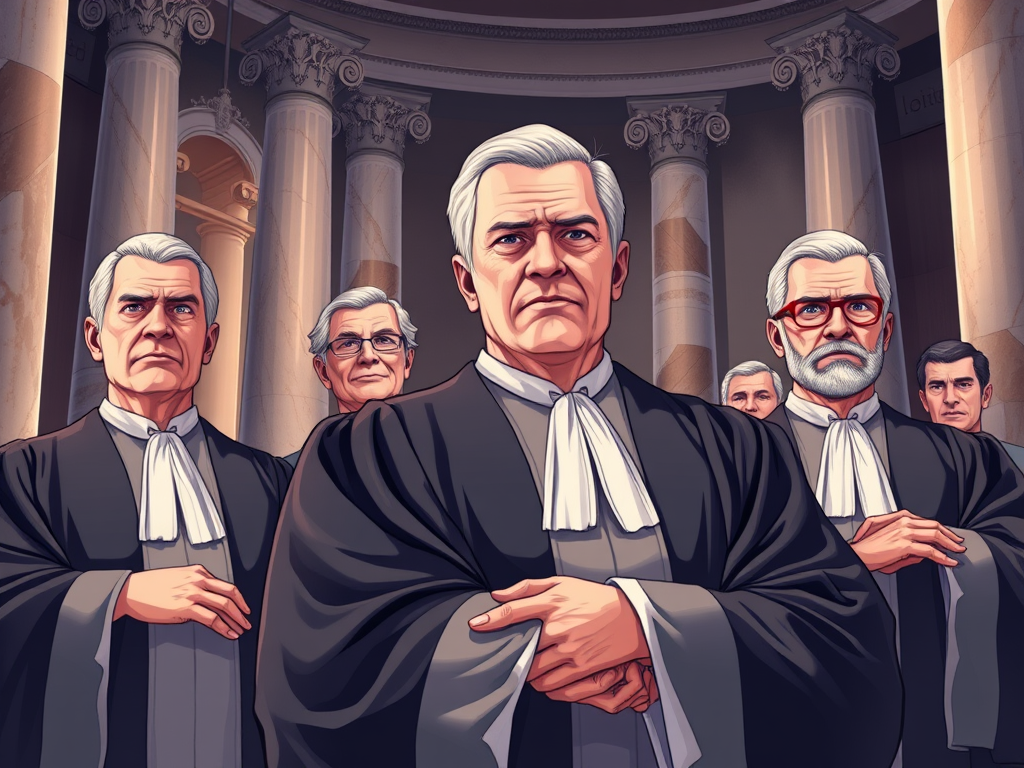
Public trust in the Supreme Court and other federal courts has plummeted. Yet paradoxically, as that trust erodes, the courts’ willingness to exert political power has grown. The gap between institutional authority and democratic legitimacy widens, but the claim of neutrality fills that gap—at least for those who want the court’s ideological direction to continue.
This narrative benefits conservative legal movements in particular. For decades, they have invested heavily in training and elevating judges who share specific policy priorities: limiting federal regulatory agencies, rolling back civil rights protections, expanding corporate power, and narrowing the scope of democracy. When those judges take the bench and execute those priorities, the rhetorical shield of neutrality protects them.
The public is discouraged from recognizing what is happening, because to say a judge is acting ideologically is treated as an attack on the institution itself. Neutrality rhetoric functions as a gag order: it warns people not to question what is being done in their name.
The Consequences for Democracy
When courts exercise enormous political power while insisting they are doing nothing political at all, democratic oversight becomes impossible. Voters can’t hold judges accountable for ideological decisions they deny making. Legislatures struggle to check courts shielded by the mythology of neutrality. Communities harmed by judicial rulings—pregnant women, workers, immigrants, voters of color—are told they are simply experiencing the rule of law.
The irony is that courts often demand “restraint” from every part of the democratic system except themselves.
The louder judges insist that they are neutral, the more aggressively they reshape the country.
Demystifying the Court Is Necessary for Accountability

Challenging the neutrality myth is not an attack on the judiciary. It is a demand for honesty. Judges are political actors with enormous power, and acknowledging that is the first step toward democratic accountability.
To recognize judicial ideology is not to reduce the law to partisan warfare. It is to insist that courts be understood as institutions with real interests, real incentives, and real biases—institutions whose decisions reflect struggle, conflict, and competing visions of the country.
Democracy cannot function when its most powerful unelected actors are allowed to claim divinity. The robe is not a shield against scrutiny, nor should the language of neutrality be accepted as proof of anything except how the powerful justify their actions.
The courts are not above politics. And the sooner we stop pretending they are, the sooner we can confront the ideological battles playing out on the bench—and build a system that is accountable to the people it governs.





 Sure Media Magazine
Leave a comment