

Sustainability Efforts for Climate Change Turnaround
Climate change is not just a distant threat — for Kenya, it’s already reshaping landscapes, livelihoods, and long-term development. But the story isn’t just about vulnerability. Kenya is also emerging as a climate leader in Africa, building resilience, reducing emissions, and forging a future rooted in sustainability. Here’s a look at some of the most promising climate change efforts in Kenya today.
1. A Clean Energy Revolution
One of Kenya’s biggest climate wins is in renewable energy. The country has tapped into its rich geothermal resources, especially around the Rift Valley, to power a significant portion of its electricity demand. (Tuko.co.ke – Kenya news.)
- According to Kenya’s climate change action plan, geothermal is projected to make up a major part of the energy mix.
- Through the Kenya Climate Change Knowledge Portal, the government highlights mitigation actions like further expanding geothermal, solar, wind, and hydropower. (kcckp.go.ke)
- These clean energy sources also feed into smarter transport systems: Kenya is promoting mass transit (like BRT), non-motorized transport (bicycles), and incentivizing efficient vehicles. (kcckp.go.ke)
These efforts contribute directly to Kenya’s greenhouse gas (GHG) emissions reduction goals: in its updated Nationally Determined Contribution (NDC), Kenya pledges a 32% cut in emissions by 2030, conditional on support. (IEA) Moreover, Kenya launched a Long-Term Low Emission Development Strategy (LT-LEDS), setting the 2050 goal of a net-zero emissions economy — though challenges remain around funding, data, and capacity. (IEA)
2. Landscape Restoration and Tree-Planting

Recognizing the role of forests in absorbing carbon, Kenya has placed ecosystem restoration at the center of its climate agenda. Through its National Climate Change Action Plan, Kenya is targeting large-scale forest restoration: degraded landscapes are being replanted, and reforestation is a key mitigation action. (kcckp.go.ke)
- The government aims to restore 960,000 hectares of degraded forest land by 2030. (kcckp.go.ke)
- Besides public pledges, there’s been grassroots mobilization. One high-profile effort: a national tree-planting campaign tied to a public holiday, part of a plan to plant 15 billion trees by 2032. (Tuko.co.ke – Kenya news.)
- These tree-planting drives are not only about carbon — they help with soil erosion, watershed protection, and habitat restoration. (Tuko.co.ke – Kenya news.)
3. Building Resilience Through Adaptation
Beyond reducing emissions, Kenya is doing a lot to adapt to the impacts that are already here or coming.
- The Kenya Climate Change Knowledge Portal highlights a variety of adaptation projects: water management, food security, and ecosystem-based interventions. (kcckp.go.ke)
- One flagship project is the Integrated Programme to Build Resilience, which supports vulnerable communities in managing water resources, scaling sustainable livelihoods, and protecting coastal ecosystems. (kcckp.go.ke)
- In arid and semi-arid lands (ASALs), Kenya is implementing “Ending Drought Emergencies” through early warning systems, contingency funds, and community-driven planning. (kcckp.go.ke)
- For water security, Kenya’s “Water Security & Climate Resilience Project” improves irrigation, strengthens water institutions, and promotes integrated basin planning. (kcckp.go.ke)
4. Innovation in Coastal Communities: Seaweed Farming
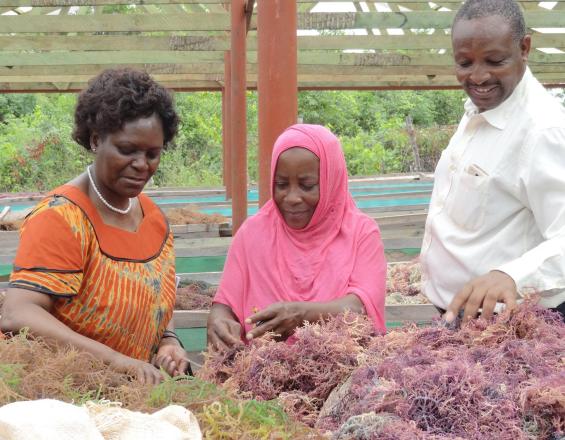
In some of Kenya’s coastal regions, rising temperatures and erratic rainfall are forcing communities to rethink traditional farming. A compelling alternative? Seaweed farming.
- In several coastal villages, seaweed farming has become an economic lifeline. What once was mainly cassava and maize is now complemented by seaweed, which can tolerate changing climatic conditions. (Reuters)
- More than 100 households are involved; the crop is processed into products like soap, food ingredients, and powders, creating both local income and export opportunities. (Reuters)
- The shift to seaweed is a smart adaptation: it builds climate resilience, diversifies incomes, and supports ecosystem restoration.
5. Climate-Resilient Health Systems
Kenya is also integrating climate change into its public health planning. The Kenya Climate Change and Health Strategy (2024–2029) charts pathways for the health sector to adapt and mitigate risks. (KEMRI)
Key priorities include:
- Using renewable energy in health facilities to reduce emissions and improve resilience. (KEMRI)
- Strengthening water, sanitation, and hygiene (WASH) infrastructure, including managing healthcare waste in climate-smart ways. (KEMRI)
- Building climate early-warning systems for disease surveillance, integrating cross-sector training, and embedding One Health principles — recognizing the links between human, animal, and environmental health. (KEMRI)
6. Community Leadership and Local Climate Action
Climate action in Kenya isn’t just top-down. Communities, especially in informal settlements and marginalized areas, are playing a key role.
- A project supported by Cities Alliance is helping community-led adaptation in Nairobi, Kisumu, Nakuru, and Mombasa. (Cities Alliance)
- Through this project, youth and local savings groups are engaging in mapping, adaptation planning, and advocating for improved water and waste management. (Cities Alliance)
- Community committees have been formed to push for local adaptation priorities such as flood control, sanitation, and climate education. (Cities Alliance)
- At the national level, Kenya is pushing for innovative climate finance: public-private partnerships, green bonds, and stronger domestic funding mechanisms are being discussed. (Kenya News)
- This push is seen as critical because, while Kenya’s ambitions are high, many climate projects still rely heavily on external funding. (IEA)
7. Livestock Adaptation: Camels over Cows
Some of Kenya’s most climate-vulnerable regions are adapting in creative ways — for example, shifting from cattle to camels.
- In drought-prone areas, camels are being distributed to herding communities because they are more drought-resilient than cows. (Le Monde.fr)
- Camels use less water, endure heat better, and produce milk even under tough conditions. For pastoralists, this shift is not just a survival strategy — it’s climate adaptation. (Le Monde.fr)
- This change also has climate-benefit side effects: camels generally emit less methane than cows, contributing to a lower emissions profile for the livestock sector. (The Washington Post)
8. Looking Ahead: Challenges & Opportunities
Despite these efforts, Kenya’s climate journey is not without obstacles.
- Funding remains a major hurdle: While the ambition is high (e.g., net-zero by 2050, 32% emissions cut by 2030), a large proportion of required investment is dependent on international support. (IEA)
- Capacity gaps: Implementing technical projects (like geothermal development or advanced adaptation) needs more skilled personnel, data systems, and institutional strength. (IEA)
- Maintenance beyond planting: Reforestation is one thing; ensuring the survival of newly planted trees in the face of changing rainfall is another. Local engagement and long-term care are critical. (Tuko.co.ke – Kenya news.)
- Equity and inclusion: Climate finance mechanisms must ensure that the most vulnerable communities — especially in rural or informal areas — benefit meaningfully from adaptation and mitigation projects.
Still, Kenya is showing that it’s possible to combine economic development with strong climate action. Its climate strategy is multi-faceted: from energy to health, from forest restoration to seaweed farming, from grassroots adaptation to policy innovation.
Why Kenya Matters on the Global Stage
Kenya’s climate leadership is not just about its own future. As a developing country with significant climate vulnerability, its success could serve as a model for other nations. By mobilizing both international partnerships and local communities, and by leveraging its natural endowments (like geothermal energy), Kenya is walking a path that others can learn from.
Moreover, Kenya’s approach underscores a critical lesson: climate change is not just an environmental issue — it’s deeply social, economic, and political. Solutions must be integrated, inclusive, and resilient.





 Sure Media Magazine
Leave a comment