
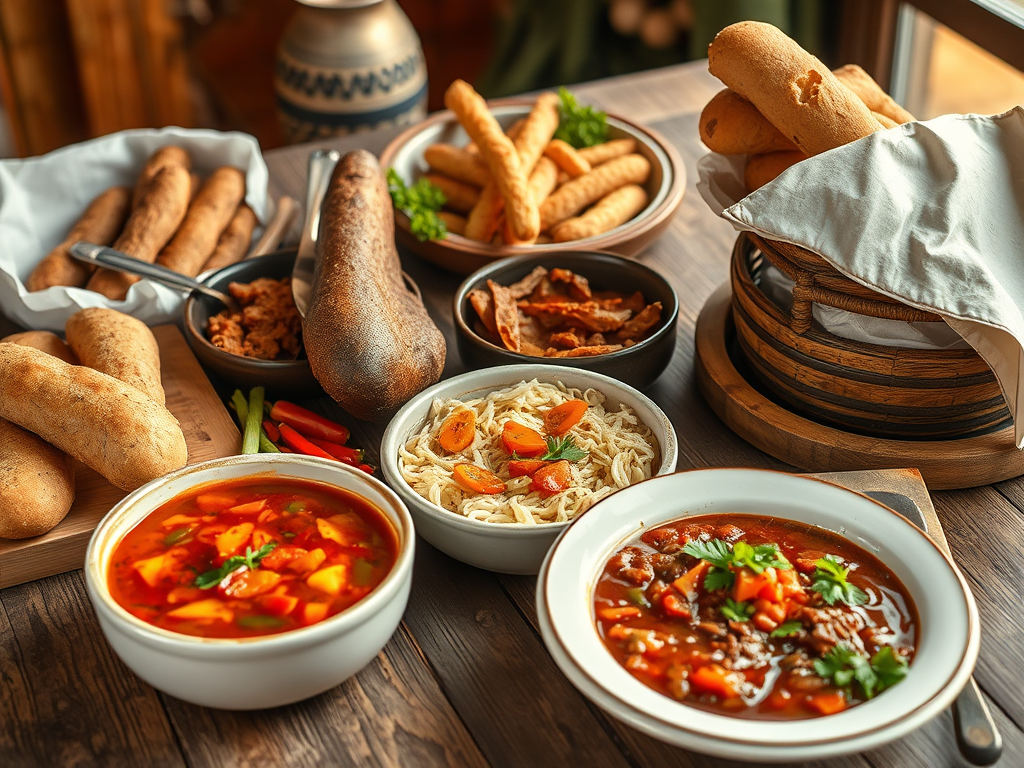
Food is never just food. It is memory, rebellion, belonging, defiance, and joy all rolled into one. Every culture and freedom are not abstract concepts debated in lecture halls—they live on our plates, in our kitchens, and in the stories we tell while passing the serving bowl. When we eat, we are tasting history. When we choose what to eat—or fight for the right to eat it—we are tasting freedom.
- Food is the most intimate expression of cultural identity, carrying ancestral knowledge across generations and borders.
- Control over food has always been a primary weapon of oppression; reclaiming it has always been a primary act of liberation.
- Culinary fusion and personal dietary choice are among the sweetest fruits of free societies.
- In 2025, battles over seed sovereignty, cultural appropriation, and even the right to throw soup at a painting show that food remains one of the most potent arenas for contesting power.
These truths are not theoretical. They are etched into Haitian Soup Joumou drunk every January 1, into the jerk pits of Jamaican Maroons, into the communal ollas of Pinochet-era Chile, and into the tomato soup splashed across Van Gogh’s Sunflowers in 2022.
The Plate as Passport: Food and Cultural Identity
Every culture has a dish that says “this is who we are.” For Haitians it is Soup Joumou—a rich pumpkin squash soup once forbidden to enslaved people but served to French masters. On January 1, 1804, after defeating Napoleon’s army, the newly independent Haitians drank it defiantly. Two centuries later, UNESCO recognized it as intangible cultural heritage precisely because it is not just soup—it is the taste of victory over slavery.
For Ukrainians it is borscht, a dish whose regional variations are so fiercely defended that arguments over “authentic” recipes have outlasted empires. When Russia invaded in 2022, borscht became a symbol of resistance; UNESCO fast-tracked its listing in 2022 explicitly as protection for Ukrainian cultural heritage under threat.
The French baguette—simple flour, water, salt, yeast—was added to the UNESCO list in 2022 not for gourmet complexity but for everyday ritual: the morning queue, the ripping (never cutting) at table, the democratic accessibility that once made it the bread of revolution.
These are not isolated cases. From Senegalese ceebu jën to Singapore hawker culture, from Armenian lavash to Palestinian maqluba turned upside-down on the platter as an act of abundance, food is the most portable, durable, and delicious form of cultural DNA. Immigrants carry seeds, spices, and techniques in their luggage the way others carry flags. When a Korean-Mexican truck in Los Angeles serves bulgogi tacos, or when a Palestinian chef in London stuffs vine leaves with lamb and serves them beside kimchi, culture is not being diluted—it is declaring its right to evolve on its own terms.
When a culture loses its food, it loses part of its soul. When it keeps its food, it keeps its freedom.
The Kitchen as Resistance Headquarters
History’s darkest chapters are full of rulers who understood that if you control what people eat, you control the people themselves.
Under slavery in the Americas, enslaved Africans were given the worst cuts of meat and scraps—pig feet, intestines, greens cooked forever to hide bitterness—turned those scraps into soul food, gumbo, feijoada, and callaloo. The act of seasoning with memory, of making something delicious out of contempt, was rebellion in every bite. In Jamaica, escaped Maroons developed jerk seasoning in hidden mountain pits, smoking meat so the smoke would not betray their location to colonial troops. The flavor we now pay premium prices for began as guerrilla cuisine.
In Nazi-occupied Europe, sharing recipes became a clandestine language of hope. Inmates in concentration camps whispered recipes to each other at night—chestnut roulade, yeast dumplings with plum jam—committing them to memory because writing them down was impossible. After liberation, many survivors wrote those recipes on whatever paper they could find. The recipes were never about the food; they were proof that the mind had remained free.
In Chile after Pinochet’s 1973 coup, the regime banned ollas comunes—communal soup pots organized by working-class women—because feeding the hungry together was considered subversive. The women cooked anyway, in secret, passing pots over backyard walls. The smell of shared beans and corn became the smell of conspiracy.
Even today, Indigenous communities in North America and Canada fight for the right to hunt, fish, and forage as their ancestors did. Seed sovereignty movements in India and Mexico battle Monsanto patents on ancient maize varieties. Palestinian cooks in diaspora kitchens insist on za’atar and sumac despite Israeli restrictions on transporting those herbs across checkpoints. Every time someone plants heirloom seeds or teaches a child to make their grandmother’s dolma, they are performing a quiet act of liberation.
Fusion Is Freedom
Only in relatively free societies do cuisines dare to marry each other.
The California roll was invented not in Tokyo but in Vancouver and Los Angeles because Japanese chefs could experiment without fear of being accused of dishonoring tradition. Tex-Mex, Cali-Mex, Korean tacos, sushi burritos, butter chicken pizza—these are not abominations; they are love letters written in the language of immigration and choice.
When David Chang opened Momofuku and put pork buns filled with Southern-style bacon on the menu, or when a Syrian refugee in Berlin starts selling manakish beside a Vietnamese pho stall, something profound happens: cultures speak to each other without translators. The marketplace of ideas becomes an actual marketplace, fragrant with garlic and possibility.
Of course, fusion has its critics. Charges of cultural appropriation fly fast when a white chef opens a “modern Vietnamese” restaurant or when quinoa prices soar after Western vegans discover it, pricing Bolivian farmers out of their staple. The tension is real. Yet the answer is never to freeze cultures in amber but to insist on credit, context, and economic justice. Freedom includes the freedom to be inspired by someone else’s grandmother—as long as you say her name.
The Personal Is Palate-able: Dietary Choice as Modern Liberty
In 2025 the battle over what we may put in our mouths has become one of the fiercest frontiers of personal freedom.
Veganism, carnism, halal, kosher, gluten-free, keto, raw, intuitive eating—never before have individuals had so many ways to declare “this is who I am” through diet. Social media amplifies the proclamations, sometimes to toxic extremes, but the underlying principle remains revolutionary: my body, my choice.
Yet that choice is still not universal. In parts of India, eating beef can land you in jail or worse. In some European cities, halal slaughter is banned under animal-rights pretexts that somehow never seem to target industrial pig farms. In China, Uyghur restaurants have been forced to serve pork and alcohol to prove their loyalty to the state. The right to eat according to conscience remains a privilege many do not have.
Even in democracies, freedom is under negotiation. School lunch programs dictate what children may eat “for their own good.” Seed laws prevent farmers from saving patented GMO crops. Ultra-processed food giants lobby against sugar taxes while addiction researchers compare their products to cigarettes. The freedom to choose is meaningless if the only choices offered are engineered to make you sick and dependent.
Throwing Soup at Masterpieces: When Food Becomes Weapon
In October 2022, two young Just Stop Oil activists threw Heinz tomato soup at Van Gogh’s Sunflowers, then glued their hands to the wall beneath it. The painting was unharmed (protected by glass), but the internet exploded. How dare they desecrate art?
They dared because they understood something ancient: food is the perfect protest projectile. It is non-violent, instantly understood, and impossible to ignore. Soup says: while billionaires buy art, ordinary people queue at food banks. Cake smeared on King Charles’s waxwork says: let them eat cake is no longer funny when people literally cannot afford bread. Mashed potatoes on Monet says: we are starving the planet for oil.
These actions descend directly from the 1766 English food rioters, the 1863 Richmond bread riot led by mothers shouting “bread or blood,” the Mexican tortilla protests of 2007 shouting “sin maíz, no hay país.” The medium has changed—the message has not. When systems fail to feed people, people will use food to make the powerful choke on their indifference.
Conclusion: A Seat at the Table for Everyone
I began writing this on an ordinary Thursday, eating a bowl of pho made by a Vietnamese family who fled Saigon in 1975, spiced with mint grown by my Palestinian neighbor, finished with a squeeze of lime from a tree in my own California backyard. The bowl contained three continents, four wars, several genocides, countless love stories, and one stubborn refusal to let any of it be forgotten.
That is what food does. It refuses amnesia.
In every preserved seed, every banned recipe cooked anyway, every fusion dish that should not work but does, every soup pot passed over a dictator’s wall, every pumpkin soup on Haitian Independence Day, every time someone chooses to eat—or not eat—according to their own conscience, we declare:
We are still here. We remember who we are. We will not be starved into submission.
The struggle for freedom is never finally won. It must be tasted anew with every meal. So cook. Share. Experiment. Fight for the right to do all three. Because as long as there are kitchens, there will be resistance. As long as there are tables, there will be culture. And as long as someone, somewhere, is free to pass the salt to a stranger, there will be hope.
Written by moses .




 Sure Media Magazine
Leave a comment