
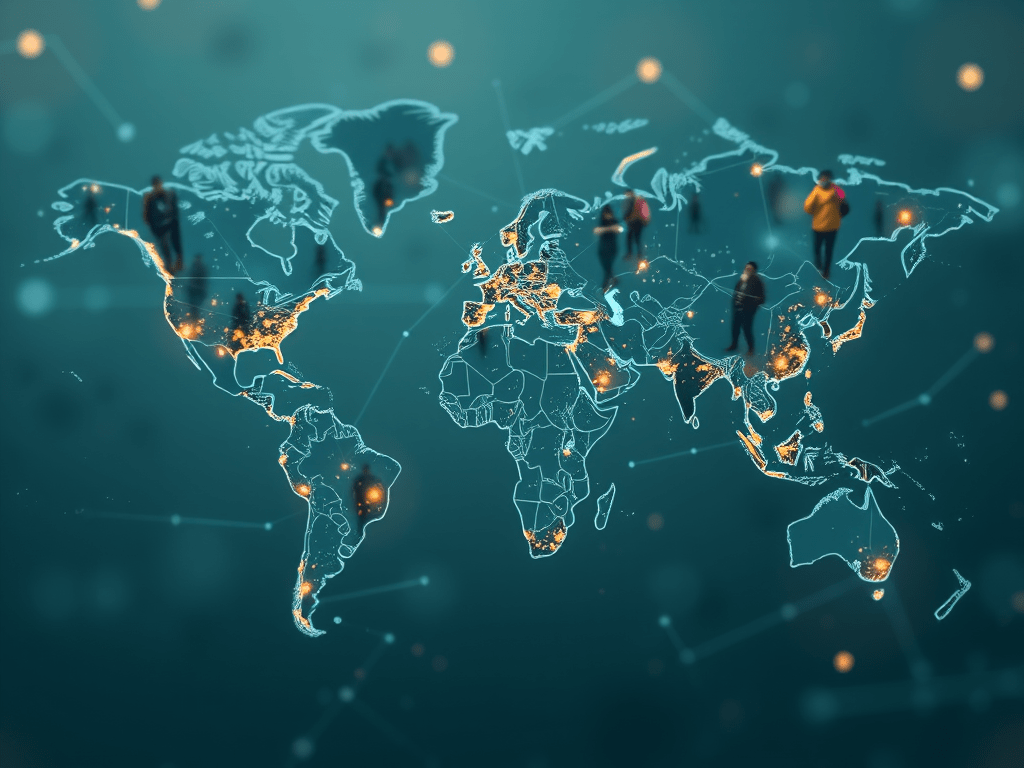
The nation-state, long regarded as the foundation of modern geopolitics, emerged from the 17th-century Treaty of Westphalia as a promise of sovereignty, identity, and territorial integrity. It offered peoples the right to govern themselves within defined borders, free from imperial domination.But in 2025 amid accelerating globalization, rapid technological transformation, mass migration, and climate disruption a provocative question hangs in the air:Is the nation-state nearing its end?And if so, could borders, those rigid lines on maps, lose their meaning within the next half-century?This is no longer a fringe theory. Scholars, economists, and policymakers have debated the nation-state’s decline for decades. Ironically, recent surges in nationalism Brexit, border walls, “America First,” and rising ethnic populism are often interpreted not as signs of strength, but as desperate spasms of a system in decay. The pressures building beneath the surface suggest that while the nation-state may not disappear overnight, its dominance is weakening, giving way to new, fluid, networked forms of governance where connectivity matters more than territory.The Cracks in the Foundation: Forces Undermining the Nation-StateFor centuries, the nation-state has relied on three pillars:1. Territorial sovereignty2. National identity3. Economic independenceToday, each of these pillars is under siege. 1. Globalization: The End of Economic BordersGlobalization transformed the world into a web of interdependent supply chains, digital economies, and multinational corporate power that often supersedes the authority of governments. Corporations can influence policy through lobbying, tax negotiations, or simply by threatening to relocate.The COVID-19 pandemic exposed how fragile national economic control truly is. A medical crisis in one country triggered shortages and chaos everywhere else. Even nationalist states had to rely on international cooperation for vaccines, technology, and medical supplies.Digital economies push this erosion even further. Remote work, cryptocurrencies, and blockchain blur fiscal borders. Why pay taxes to a nation when your economic life exists on a borderless internet?By 2075, some analysts predict global trade could quadruple, with AI-driven economies reducing the relevance of physical borders altogether. Even geopolitical tensions—such as the U.S.-China decoupling do not reverse globalization; they simply reshape it into selective alliances that bypass traditional boundaries.2. Migration: Humanity Is on the MoveBorders were meant to contain populations, but mass migration is rendering them porous and politically unstable. Climate change, conflict, and economic inequality could displace up to 1.2 billion people by 2050, overwhelming national systems.Examples are already visible:Europe’s Schengen Zone has effectively erased internal borders.African and Asian migration networks form transnational communities that maintain strong economic and cultural ties across continents.Remittances sent by migrants now exceed foreign aid many times over, proving that people’s movements, not governments, drive global economic influence.At the same time, states are experimenting with digital border control—AI surveillance, biometric systems, and predictive algorithms—but these tools often deepen inequality and fail to stop migration. Human beings simply relocate where survival is possible.In this reality, physical borders matter less than the flows of people, money, and ideas.3. Technology: New Powers Beyond the Control of StatesThe internet does not recognize borders. Neither do cyberattacks, pandemics, AI systems, or global corporations.This creates supranational forms of power:The EU, WTO, and UN enforce rules that override national laws.Companies like Meta, Google, TikTok, and X shape political discourse across entire continents.AI models influence elections, public opinion, labor markets, and information access often faster than governments can react.Quantum computing, biotech, and space exploration will further challenge national authority. Some theorists predict the return of a “new feudalism,” where global elites, mega-cities, and corporate entities wield more influence than traditional states.In such a world, sovereignty becomes less about territory and more about control over data, algorithms, and networks.Counterarguments: The Nation-State Isn’t Dead YetDespite its vulnerabilities, the nation-state is not collapsing quietly.Its defenders argue that claims of its death have been exaggerated.A Resurgence of NationalismEvents from Brexit to the U.S.–Mexico border wall to India’s citizenship laws demonstrate strong public demand for sovereign control. Wars in Ukraine and the Middle East reinforce the reality that borders still define conflicts and loyalties.Even “deglobalization” trends such as reshoring factories or restricting foreign investment strengthen national power.Identity Still MattersNational identity provides stability, belonging, and collective purpose.Without it, critics warn, societies could fracture into chaos.Grassroots movements on social platforms often demand stronger borders, not weaker ones, reflecting real fears of cultural erosion and economic displacement.The nation-state is resilient because there is no widely accepted alternative yet.What Comes After the Nation-State?If borders fade, new governance models could emerge:1. City-States & Mega-RegionsPowerful cities like Nairobi, Lagos, Istanbul, and Singapore could become semi-autonomous centers of political and economic life much like medieval city-states.2. Regional Super-StatesOrganizations like the EU or African Union may evolve into powerful political unions with shared laws, currencies, and defense systems.3. Corporate GovernanceTech giants may effectively govern digital populations through platforms that shape communication, commerce, and identity.4. Digital NationsOnline communities organized around shared values or economic networks could form borderless “digital states.”5. Hybrid GovernanceThe future may blend all of the above: cities, corporations, online communities, regions, and weakened nation-states sharing power.
Conclusion: A Fading ParadigmThe nation-state is not dead, but it is undeniably aging.Globalization, mass migration, AI, and climate disruption are eroding its foundations faster than many leaders acknowledge. Nationalism may buy time, but it cannot reverse economic interdependence or halt technological change.Over the next 50 years, borders may persist symbolically while power flows through networks—digital, economic, climatic, and cultural.The world is entering a post-national era, with new winners and losers.And as history shows, political systems do not last forever.Empires rose and fell.Feudal kingdoms disappeared.And perhaps the nation-state, too, will one day become a relic of a world that no longer exists.





 Sure Media Magazine
Leave a comment