
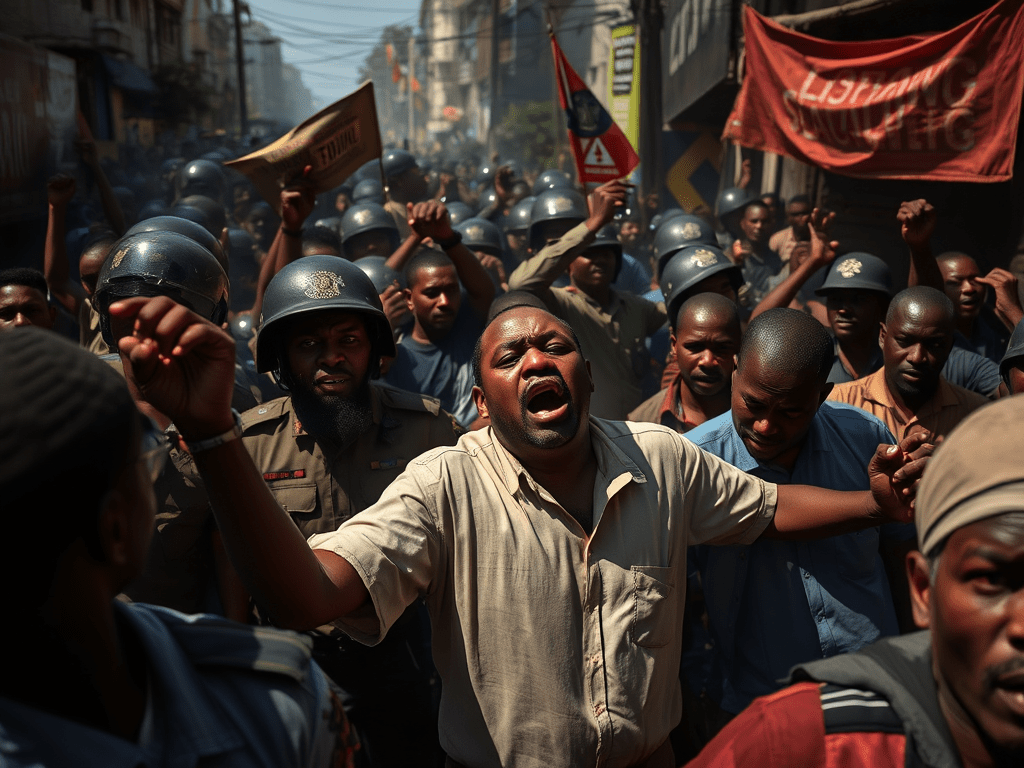
Tanzania’s 2025 election was supposed to be a moment of clarity—a chance to reset, to breathe, to choose. Instead, for countless families, it became a line drawn in fear. On one side was the fragile rhythm of daily life; on the other, the darkness of silence, internet blackouts, and state violence.
Caught between the two were ordinary citizens—mothers, brothers, teachers, vendors—people who never asked to become witnesses to brutality. Among them was Amina, a shopkeeper and mother whose life changed with a single gunshot.
What follows is her story.
Amina’s Story: Tanzania After the Vote
Before everything changed, Amina’s mornings followed a familiar script. The neighbor’s rooster would cry out at 5:30 a.m., dragging her from sleep. She’d gently part and braid Neema’s hair, humming to keep the little girl still. She’d tuck a warm serving of ugali and beans into a lunch tin, kiss her forehead, and squeeze onto a noisy dala-dala bound for Kariakoo.
Life wasn’t perfect—rent was a constant worry, the electricity never behaved—but it had a heartbeat she understood.
That heartbeat stumbled on October 29, 2025.
When the Election Felt Like a Joke
Amina didn’t cast her ballot. By the time she reached the polling station, the line had collapsed into shouting. A man in a CCM cap waved money openly. People muttered curses. Someone yelled, “This is witchcraft, not voting!” Amina stood there for a moment, then walked home, angry and tired.
Days later, the radio announced the results with a straight face: 97.66% for the president.Amina burst into a laugh that surprised even her—sharp, humorless.“Even your grandmother doesn’t love me that much,” she told Neema, trying to make it sound like a joke.
But beneath the laughter, something cracked inside her.
When the Internet Died and the Streets Exploded
On November 1, everything went silent. WhatsApp froze. News disappeared.
Then came the bangs—loud, close, wrong.
Amina was closing her shop when she heard them.
Her heart leapt because Juma—her little brother who still called her hero—had gone to a rally in Magomeni. She ran.She found him in a narrow alley, lying too still, his shirt soaked deep red.“They shot him… he was live-streaming,” a boy whispered.
Amina held Juma’s face in her hands. His eyes were open, as if he still had something left to say.
He never got the chance.Later, police called him a thief.
A looter.Amina looks at the Eid photo on her cracked phone—him smiling so widely his eyes nearly disappeared—and wonders how they could lie so easily.
The List That Shouldn’t Exist
By November 5, Amina’s small notebook had become a graveyard of names. People who vanished overnight:
- Fatma, the gentle nurse.Selemani, who never refused anyone a ride.
- Mr. Kijazi, the teacher who bought chalk with his own money.
Each name felt heavier than the last.At the police station, she tried to report them.
The officer shrugged. “Hakuna kesi.”No case.It felt like someone telling her these people had never existed at all.
Life Under Curfew
Every evening at exactly 6 p.m., the streets emptied so quickly it felt like the whole city was holding its breath.
Amina cooked in darkness. The candle flickered as though afraid.Neema started drawing people without faces.She stopped asking about Juma.
One night, soldiers kicked in a neighbor’s door.Amina pulled Neema onto her lap, covered her ears, and whispered,“Count to one hundred. If they come here, we hide in the maize sack.”
They didn’t.But fear stayed behind—an unwelcome guest that seemed to settle in every corner.
Leaders Talk Healing While Bodies Pile Up
On November 13, the president named a new Prime Minister. He spoke on TV about unity, progress, confidence. His tie was perfectly straight.Amina muted the screen.That same day she was at the morgue again.The attendant slid a tag across the table: John Doe #217.Everyone looked tired. Everyone looked haunted.
Amina touched the cold metal tag and thought of Juma teasing her chapatis:“You’re ruining Tanzania’s reputation, sister!”Her chest tightened until she could barely breathe.
Quiet Rumors, Quiet Hopes
In the market, conversations are now shadows—short, cautious, disappearing mid-sentence.A vendor slipped Amina a folded note with her kitenge.“MD9. Tunatoka.”December 9. We come out.Amina doesn’t know if she will go. She wants to.She’s scared.Neema still wakes up crying.Still, she tucks the note into her bra, right next to Juma’s photo.-
A Small, Fierce Act
This morning, before sunrise, Amina unlocked her shop and hung a new sign:Kwa Juma. Kwa Fatma. Kwa wote.For Juma. For Fatma. For all of them.Customers came quietly. Some cried. Some left money without speaking.An old man held her hand and said,“Tell your daughter her uncle was a brave man.”She couldn’t answer.The words stuck in her throat like stones.—
The Rooster Still Crows
At 5:30 a.m., the rooster still shouts like nothing has changed.Amina still braids Neema’s hair.The dala-dala still rattles through Tandale—though half the drivers are missing.Life limps forward.And when Neema asks softly,“Mama… will Uncle Juma ever come back?”Amina pulls her close and whispers the only truth she can carry:“He lives in the hearts of people who refuse to forget him.”For now, that is all she has.And she holds onto it like hope.-
Conclusion
Amina does not see herself as an activist. She is not a leader, not a fighter, not a revolutionary by choice. She is simply a mother who lost a brother and refuses to let the world pretend he never existed. In a country where truth is dangerous and silence is rewarded, her courage is quiet but unmistakable.Every name in her notebook is a life that mattered.
Every tear she wipes from Neema’s cheek is a promise that memory will outlive fear.And every morning the rooster crows, she rises again—not because life has healed, but because she refuses to surrender to forgetting.
In her hands, grief becomes resistance.Hope becomes responsibility.And remembrance becomes an act of defiance no government can erase.
Call to Action
If Amina’s story moved you, don’t let it fade into silence.Share it.Speak their names.Stand with families still searching, still grieving, still waiting for truth.Silence protects those who abuse power—but storytelling protects those who suffer under it.
Remember them.
Honor them.Refuse to forget.





 Sure Media Magazine
Leave a comment