
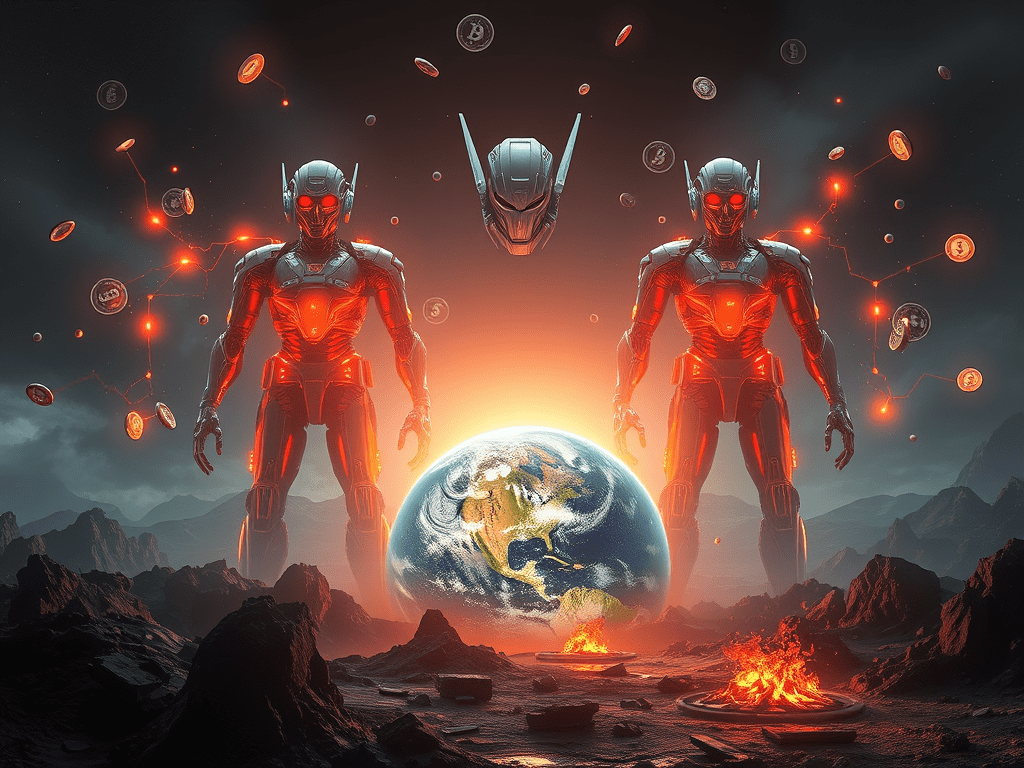
The satellites above see no borders.
They stream data from flooded coastlines, burning forests, and neon-lit cities—indifferent to flags below. In this silent web of code, money flashes through invisible arteries while artificial minds whisper to one another across oceans. The planet has become one vast nervous system. And the map, once our sacred text of power, is turning obsolete ink.
The Map Is Losing Meaning
For centuries, geography told us who we were. Borders defined belonging; empires marked destiny. But in the twenty-first century, the forces that truly move the world—artificial intelligence, capital, and climate—have broken free from the lines we drew.
Data flows ignore customs. Capital flees taxation. Climate disaster doesn’t need a visa. Yet politics clings to the fantasy that territory equals control.
The world hasn’t ended—but geography, as a political idea, just might have.
The Nation as a Fading Machine
The nation-state was once humanity’s greatest invention. It centralized authority, minted identity, and gave order to chaos. For centuries, sovereignty over land meant sovereignty over fate.
That logic worked when industry was local and power was physical. But as Benjamin Bratton argues in The Stack, sovereignty has migrated into digital infrastructures—an invisible architecture of power beyond the reach of parliaments or presidents.
We are still governed, but not by the systems we vote for.
The Rise of Algorithmic Power
Artificial intelligence has become the most borderless empire ever created. It doesn’t conquer; it predicts. It decides what billions see, buy, and believe—from Nairobi to New York.
Companies like OpenAI, Google, and ByteDance now shape human behavior with machine precision. As Shoshana Zuboff warned in The Age of Surveillance Capitalism, we live under a radical asymmetry of knowledge: machines know everything about us, while we know nothing about them.
The new rulers don’t carry guns. They carry code.
Capital Without Borders
If AI is the brain of the new world, capital is its bloodstream. Trillions pulse through financial systems daily, moving faster than any government can comprehend.
Economist Dani Rodrik, in The Globalization Paradox, put it bluntly: democracy, sovereignty, and global markets can’t coexist—one must yield. And it’s sovereignty that has surrendered.
From cryptocurrencies to algorithmic trading, money no longer lives in countries; it lives in clouds. What was once a national economy has become planetary weather—fluid, chaotic, and uncontainable.
Power has left parliaments and found refuge in the network.
Climate: The Stateless Crisis
Nothing exposes the failure of geography more brutally than the climate crisis. Droughts, floods, and wildfires now cross borders as easily as broadband.
As philosopher Bruno Latour wrote in Facing Gaia, the planet itself has become a political actor—no longer a passive backdrop but an enraged participant. Yet our governments treat it as an issue of policy rather than survival.
Scholar Thomas Hickmann and colleagues note in Earth System Governance that carbon politics remain splintered—each state defending its emissions rights as if the sky were a private estate.
You can’t solve a planetary problem with 200 national egos.
The Fracturing of Citizenship
Citizenship once meant safety: a passport, a home, a vote. But what happens when your economic fate depends on global algorithms, and your survival depends on someone else’s carbon footprint?
We are migrating into digital nations—borderless identities like Estonia’s e-Residency, decentralized organizations, fandoms, and online movements. Belonging now follows connectivity, not geography.
Sociologist Payal Arora, in The Next Billion Users, calls this a civilization defined by digital belonging—a world where our truest citizenship may be to the network itself.
The passport is losing its monopoly on identity.
The Search for New Governance
In the ruins of the nation-state, new governance is quietly emerging. Blockchain collectives test transparent, programmable democracy. The European Union—for all its bureaucracy—remains the most successful experiment in post-national coordination.
Climate treaties, carbon markets, and digital IDs echo what Kate Raworth envisions in Doughnut Economics: a world balanced between human prosperity and planetary limits.
These experiments are blueprints for what comes next—systems that govern not just nations, but networks and nature itself.
The Moral Lag
Technology accelerates faster than morality can follow. We’ve built intelligence without wisdom, scale without conscience.
As both Zuboff and Bratton remind us, progress isn’t the enemy—moral progress is. We must build accountability without borders and responsibility without nations. Otherwise, the end of geography becomes the end of democracy.
The Citizen of Tomorrow
The citizen of tomorrow won’t belong to a flag. They’ll belong to a planet. To a network. To a shared, fragile web of code and climate.
They’ll live in a world where power flows through algorithms and atmosphere alike—where the new borders are made of bandwidth and weather patterns.
And when they look at the map, they’ll see it for what it always was: a story we told ourselves about control.
What’s collapsing isn’t civilization.
It’s the illusion that it could ever be contained by lines.




 Sure Media Magazine
Leave a comment