
The alleged support provided by the United Arab Emirates (UAE) to the Rapid Support Forces (RSF) in Sudan’s civil war has not only extended the duration of the conflict but has also amplified its toll on civilian lives, transforming abstract geopolitical maneuvers into tangible human tragedies. As of November 2025, this involvement has been associated with over 150,000 fatalities, the displacement of more than 12 million individuals, and acute food insecurity impacting nearly 25 million people—approximately half of Sudan’s population. Beyond these figures lie the narratives of survivors whose experiences underscore the profound ethical and humanitarian costs. This article examines the escalation of atrocities, the resulting humanitarian catastrophe, and international responses, while centering the voices of those directly affected to illustrate the severity of the crisis.
Escalation of Atrocities and War Crimes Through Personal Testimonies
The RSF, reportedly equipped with UAE-supplied armaments including guided bombs and howitzers, has been accused of committing systematic war crimes and crimes against humanity, particularly in Darfur. The capture of El Fasher in late October 2025 exemplifies this, with reports of 1,500 to 2,000 civilian deaths through mass killings, executions, and assaults on medical facilities. Survivors’ accounts reveal the ethnic targeting of non-Arab groups, such as the Masalit, involving massacres, sexual violence, and torture—actions deemed indicative of genocide by the United States in January 2025.
Abdallah Hassaballah, a survivor treated for injuries after fleeing El Fasher, described walking for two days while wounded: “I walked for two days while I was injured.” He recounted how RSF forces turned the city into a “slaughterhouse,” killing civilians indiscriminately and looting aid supplies. Similarly, Fatuma Abdallah Hassan fled with three orphaned children after a drone strike—allegedly facilitated by UAE-backed technology—killed their parents and brother while they were fetching food: “They went to bring breakfast. On the way back, the drone hit them.” These strikes have left neighborhoods in ruins, with bodies lining the streets and survivors enduring infected wounds from bullets and shrapnel.
In another harrowing testimony, a Sudanese woman displaced from El Fasher detailed the massacres: “She fled to Tawila in North Darfur State, only to find nothing there as well, and called for urgent food distribution.” Yahya Abdullah, a father of four, lost his wife in an RSF drone strike and escaped under gunfire: “The streets were full of corpses. We reached one of the sand barriers set up by the militia, and they were shooting at men, women, and children with machine guns. I heard one of them say, ‘Kill them all, don’t leave anyone alive.’” Under the cover of night, he and his children evaded detection and reached a displacement camp, highlighting the constant fear and loss.
Rasha, a mother searching for her sons amid the chaos, was sexually assaulted by RSF members: “I told them I was old enough to be their mother, and I cried, so they finally let me go.” She fled with her daughters, leaving her sons’ fate unknown due to severed communications. Alkheir Ismail narrowly escaped execution when recognized by a former university acquaintance among the assailants: “There was a young man I studied with at the university. He told them, ‘Don’t kill him.’ After that, they killed the rest of the people.” Fatima Abdulrahim walked for five days after RSF forces looted her possessions, noting her group’s relative fortune: “The girls in the group that came after us had been raped, but our girls were not.”
These violations of international humanitarian law perpetuate ethnic cleansing patterns akin to the 2003 Darfur genocide, with survivors like Qisma Ali Omar enduring torture before her death, as documented in videos circulated by perpetrators. The United Nations Secretary-General has characterized the crisis as “spiralling out of control,” calling for urgent intervention to address these crimes against humanity.


The Humanitarian Catastrophe: Stories of Starvation and Displacement
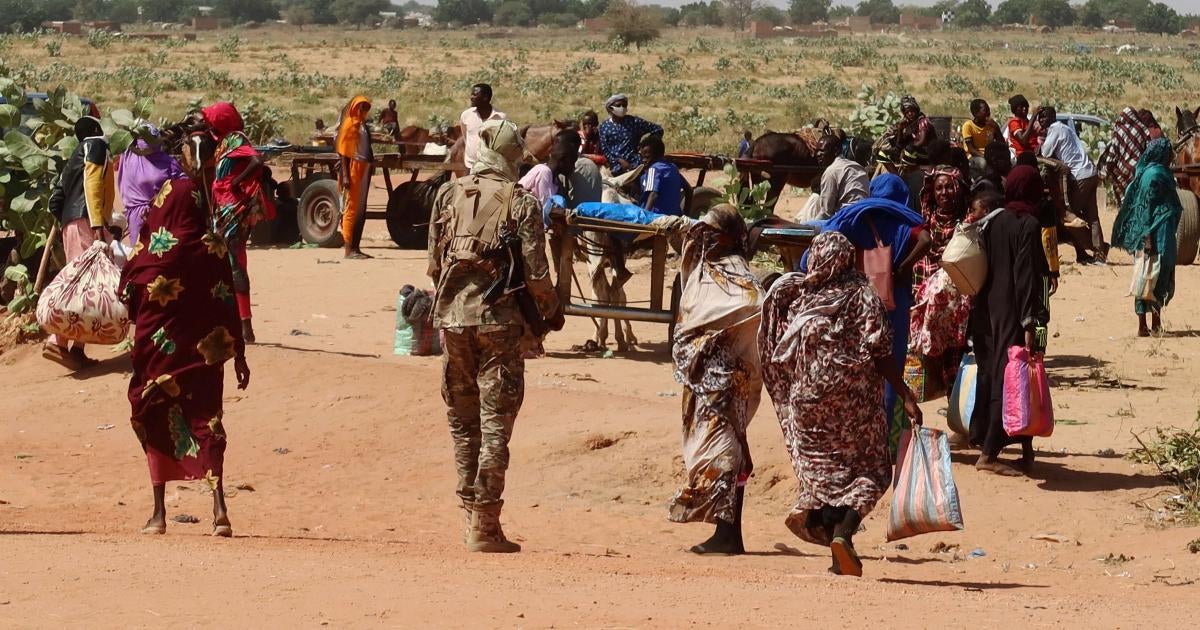
The RSF’s blockades of aid routes, allegedly supported by UAE logistics, have intensified a humanitarian emergency, creating famine-like conditions in camps such as Zamzam. Around 24 million Sudanese experience acute food insecurity, with children particularly vulnerable to severe malnutrition and disease. In one instance, RSF forces converted a school into a prison where 465 of 648 detainees died from starvation and neglect, their bodies interred in a mass grave. This deliberate use of famine as a weapon disproportionately impacts non-Arab communities, forcing mass displacements into neighboring Chad.
Ibrahim, who returned to El Fasher to procure food for his starving family, witnessed kidnappings and executions: “Pay up or be executed.” Another account from Salha describes families pooling resources to escape, only to face RSF ambushes where men were stripped, beaten, and killed—including a father and his four-year-old son. Amnesty International reports escalating attacks in Kordofan that obstruct aid, collapsing healthcare systems and essential services. The economic devastation, including an 80% drop in state revenues and the funneling of billions in gold resources to the UAE, sustains this resource-fueled conflict, leaving survivors like those in Tawila without basic necessities.


International Condemnation and the Call for Accountability
Global reactions highlight the crisis’s gravity: Sudan pursued legal action against the UAE at the International Court of Justice in March 2025, alleging genocide complicity via RSF support, though dismissed on jurisdictional grounds. The United States has sanctioned UAE entities funding the RSF, and the UN advocates extending the Darfur arms embargo to limit foreign interference. Despite UAE denials and assertions of pursuing stability, November 2025 admissions from UAE officials acknowledge policy missteps, such as failing to sanction coup leaders. This involvement threatens Horn of Africa stability, involving proxies from Egypt, Russia, and others, while hindering mediation.
Survivors and advocates, including journalists like Muammar Sud, emphasize foreign roles: “Freelance journalist reports from within El Fasher, detailing how RSF forces armed with drones, artillery, and foreign mercenaries are carrying out mass atrocities, as mounting evidence implicates the UAE.” Threads documenting crimes, such as hangings and rapes, underscore the need for accountability: “This is a horrific thread. Documenting some of the horrific crimes committed by the UAE-backed RSF militia in El-Fasher.”
In conclusion, the UAE’s alleged backing of the RSF has prolonged Sudan’s civil war and magnified its humanitarian and ethical repercussions, manifesting in the shattered lives of individuals like Abdallah, Fatuma, and Yahya. Immediate, unified international efforts—including sanctions, arms embargoes, and justice mechanisms—are crucial to alleviate this suffering and ensure accountability for those exacerbating the crisis
Copyright Notice: © 2025 Cupido. All rights reserved. This content is generated by Brayo Chopra. Reproduction, distribution, or use of this material without explicit permission from Cupido is prohibited. Images and citations are sourced from publicly available web content and are used under fair use principles for educational and illustrative purposes; original copyrights remain with their respective owners.





 Sure Media Magazine
Leave a comment