
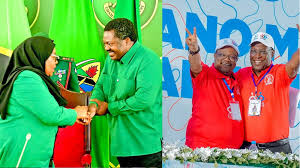
As the sun rose over Dar es Salaam on October 29, 2025, tear gas clouds choked the air and gunfire echoed through the streets, turning what should have been a day of democratic renewal into a slaughterhouse. Young protesters, waving placards demanding “Free and Fair,” faced down riot police in a desperate bid to salvage an election already rigged by disqualifications and disappearances. By nightfall, at least 10 were dead—though opposition voices whisper of hundreds—marking the moment Tanzania’s fragile democratic facade shattered under President Samia Suluhu Hassan’s iron grip.
The 2025 Tanzanian general elections, meant to test the reformist promise of Hassan’s presidency, instead exposed a deepening authoritarian slide: opposition leaders jailed or barred, ballots stuffed amid blackouts, and post-vote protests met with lethal force. This article dissects the premeditated erosion of rights—from abductions to internet shutdowns—that transformed a multiparty milestone into a mockery of democracy, questioning whether Tanzania’s 64-year-old ruling dynasty can ever yield power without bloodshed.
The Shadow Campaign: Silencing Dissent Before the Ballots
Hopes flickered briefly when Samia Suluhu Hassan ascended to the presidency in 2021 following John Magufuli’s death, her ascension as Tanzania’s first female leader sparking whispers of liberalization. Yet, by early 2025, those embers had dimmed into dread. The ruling Chama Cha Mapinduzi (CCM), in power since independence in 1961, orchestrated a pre-election purge that Human Rights Watch described as “intensified political repression.” Over 70 opposition figures and activists vanished, echoing more than 200 enforced disappearances since 2019 documented by UN experts.
At the epicenter stood Tundu Lissu, the fiery Chadema leader who survived a 2017 assassination attempt. Arrested in April after a rally calling for electoral reforms, he faced treason charges for a social media video “inciting rebellion.” Denied physical court appearances, Lissu languished in jail, his party disqualified in April for refusing an “unconstitutional” code of conduct. ACT-Wazalendo’s Luhaga Mpina, a former minister turned rival, was barred on a technicality—insufficient party tenure—leaving Hassan without credible challengers.
Journalists and activists fared no better. Two regional witnesses—Kenyan Boniface Mwangi and Ugandan Agather Atuhaire—disappeared en route to Lissu’s trial in May, later surfacing tortured and dumped at borders. Media outlets faced suspensions, cybercrime laws muzzled online dissent, and even a major Pentecostal church lost registration after its founder decried the abductions. As one rights activist told The Washington Post, “This is a sham election.”
Polling Day Inferno: Blackouts, Bullets, and Ballot Fraud
October 29 dawned under a nationwide internet and electricity blackout, severing Tanzania from the world and silencing real-time scrutiny. Mobile data crumbled, social media vanished, and journalists—two of whom spoke to Human Rights Watch—were crippled in their reporting. In Dar es Salaam, Kigoma, and Arusha, queues formed amid chaos: CCM agents allegedly stuffing ballots, observers obstructed, and military excess unchecked.
Protests ignited instantly. In the capital, water cannons blasted crowds, while gunfire felled demonstrators chanting against the “coronation.” A curfew clamped Dar es Salaam at 6 p.m., but clashes raged into the night, with Muhimbili Hospital overwhelmed by the wounded. The African Union’s 72 observers decried the farce: “Ballot stuffing, internet blackout, and politically-motivated abductions compromised integrity.” By day’s end, UN reports confirmed at least 10 deaths from security forces’ excessive force.
Hassan’s 98% landslide, declared November 1, rang hollow. European Parliament voices branded it “neither free nor fair,” citing irregularities and fear. Chadema claimed 700 slain in the unrest; diplomats whispered of 500. Amnesty International slammed the blackouts as tools to “suppress and document violations,” urging probes into killings.
The Reckoning: A Nation in Mourning and Mobilization
By November 3, as Hassan was sworn in amid armored streets, the toll mounted: over 1,000 arrested, blackouts persisting in pockets, and the army deployed nationwide. The UN, African Commission, and foreign ministers from the UK, Canada, and Norway condemned the “grave violations,” calling for restraint and rights restoration. Yet, Foreign Minister Mahmoud Thabit Kombo dismissed excesses, insisting on “fair” conduct with “no figures” on the dead.
Exile voices like Lissu’s allies decried a “coronation, not a poll,” with troops patrolling deserted avenues. Gen Z protesters, bonding improbably with some defense forces, symbolized a youth revolt against CCM’s stranglehold. As Pope Leo urged dialogue from the Vatican, the question lingered: Could this inferno forge reforms, or merely entrench tyranny?
In the smoldering aftermath of Tanzania’s bloodied ballots, democracy’s breach isn’t just a stolen vote—it’s a scar on a generation’s soul, reminding East Africa that power conceded at gunpoint is power forever contested in the streets. As one protester scrawled on a charred barricade: “We voted with our lives; now they count the ghosts.”





 Sure Media Magazine
Leave a comment