
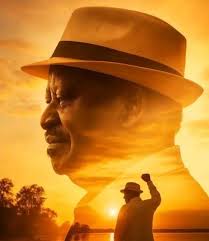
In the misty dawn of a Kerala morning, as the first rays pierced the palm-fringed paths of an ancient Ayurvedic retreat, Raila Odinga—Kenya’s indomitable “Agwambo,” the mysterious one—took what should have been a routine stroll. Minutes later, he lay motionless, his pulse fading like the echoes of protest chants that had defined his life. At 80, the man who survived torture, coups, and five presidential heartbreaks met his end not in the chaos of Nairobi’s streets, but in the quiet embrace of Indian healers. Was it fate, frailty, or something far more sinister?
Raila Odinga’s death on October 15, 2025, from cardiac arrest during a medical retreat in India, has plunged Kenya into a whirlwind of grief, speculation, and political vertigo. This article unravels the conflicting reports, whispered premonitions, and rampant misinformation that have shrouded his final hours, revealing how a routine health trip spiraled into a national enigma—and what it means for Africa’s most enduring democracy.
The Build-Up: A Body Betrayed by Time
Raila Odinga wasn’t a stranger to health battles. The veteran opposition leader, whose nickname “Agwambo” in the Luo language evoked his enigmatic aura, had long navigated the toll of a life in the crosshairs of power. Imprisoned for nine years—six in solitary—under Kenya’s one-party regime, he endured beatings, isolation, and the unyielding grind of activism that twice nearly claimed his presidency.
By late 2025, age and ailments were closing in. Odinga, then 80, grappled with diabetes, hypertension, and chronic kidney disease. Whispers of a mild stroke in Kenya prompted his evacuation to India on October 10, a destination chosen for its holistic Ayurvedic treatments. The Sreedhareeyam Eye Hospital in Koothattukulam, Kerala, held personal significance: It was here that his daughter, Rosemary, had regained her sight years earlier after a debilitating illness.
His brother, Senator Oburu Oginga, downplayed the severity just days before. “Raila is up and about,” Oburu assured Kenyans on October 11, dismissing rumors of critical condition as “just like every human being sometimes becomes indisposed.” Yet, behind the scenes, tensions simmered. Reports emerged of heated disagreements among Nairobi doctors over his diagnosis—some pushing for aggressive intervention, others advocating the serene recovery path to India. Oburu later confided in family circles about “fears and premonitions” haunting Raila’s final weeks, a shadow of unease that family lore now casts as prophetic.
The Collapse: A Walk into Eternity
October 15 dawned humid and serene at the Ayurvedic facility. Odinga, ever the restless spirit, set out for a morning walk around 6 a.m., his aides trailing at a respectful distance. Eyewitness accounts from hospital staff paint a harrowing scene: Midway through the stroll, he staggered, clutched his chest, and crumpled to the dew-kissed ground. No pulse, no blood pressure—revival efforts began instantly, but the damage was irrevocable.
Rushed to the nearby Devamatha Hospital, a team of Indian physicians battled for over an hour with defibrillators and adrenaline. “At the time of admission, Mr. Odinga had no measurable vital signs,” one doctor recounted, his voice heavy in a statement to local media. Cardiac arrest was the official verdict, tied to his pre-existing conditions and possibly exacerbated by the stroke’s aftershocks. Indian authorities notified Kenya’s Foreigners Regional Registration Office per protocol, and his body was prepared for repatriation amid a flurry of diplomatic cables.
But here’s where the mystery thickens: Why the conflicting diagnoses? Kenyan insiders whisper of a last, frantic call from Odinga to Oburu hours before the walk, his voice uncharacteristically frail, hinting at “unseen pressures.” Was it the weight of unfinished political battles—his recent loss in the African Union Commission race, or the fragile truce with President William Ruto—or something more acute, like undetected complications from the stroke?
The Storm of Rumors: Misinformation in the Mourning
As news ricocheted from Kerala to Nairobi, Kenya’s digital veins pulsed with falsehoods. Social media erupted with doctored clips: One viral video, timestamped hours after the announcement, showed a figure resembling Odinga shrouded in a white sheet, captioned “Witnessing Raila Odinga’s Last Moments.” Fact-checkers swiftly debunked it as recycled footage from an unrelated 2017 hospitalization in Mombasa.
Another frenzy involved a wailing woman in red, filmed at a supposed vigil, claimed to be Odinga’s widow, Ida. In truth, Ida was in their Karen home in Nairobi, coordinating with Ruto, who arrived unannounced to console the family. Hundreds of supporters, waving sacred twigs to banish evil spirits, flooded the gates, their cries mingling with chants of “Baba! Baba!”—the affectionate Swahili for “father.”
The deluge wasn’t accidental. In a nation where Odinga embodied resistance, his death fueled conspiracy mills: Poisoning plots, foreign meddling, even divine retribution for his “handshake” deals with foes. A YouTube documentary, “The Paper Trail: Inside the Mysterious Death of Raila Odinga,” amplified these, promising “investigative reconstruction” but leaning on anonymous sources and grainy leaks. Analysts like Wafula Buke, an Odinga ally, lamented in eulogies: “Odinga was buried by his enemies… We are deleted from his last story.”
The Aftermath: A Nation Grapples with the Void
Odinga’s repatriation on October 17 triggered seven days of national mourning, declared by Ruto, his onetime rival turned uneasy partner. The state funeral in Nairobi’s Uhuru Park drew African titans—Mahmoud Ali Youssouf of the AU hailed him as a “towering figure in democracy”—but cracks showed. Mourners clashed with police at memorials, tear gas canisters hissing like old grudges revived.
Politically, the vacuum looms large. Odinga’s Orange Democratic Movement (ODM) fractures without his glue, leaving Kenya’s opposition adrift amid Ruto’s tightening grip. “This was not the time for Raila to die,” mourned veteran Koigi wa Wamwere, fearing a “heavy-handed state” unchecked. Oburu Oginga, co-chairing funeral logistics with Deputy President Kithure Kindiki, spoke of a “mixed legacy of hope and doubt,” but vowed the mourning endures: “Raila touched too many lives. The vacuum will take a long time to fill.”
In the end, Raila Odinga’s death—whether cruel twist of biology or deeper intrigue—mirrors the man himself: a riddle wrapped in resilience, leaving Kenya to ponder not just how he fell, but how to rise without its most mysterious architect. As Oburu reflected, their shared shoes and stories now walk alone, but the footprints? They’ll echo through elections yet unborn.





 Sure Media Magazine
Leave a comment