
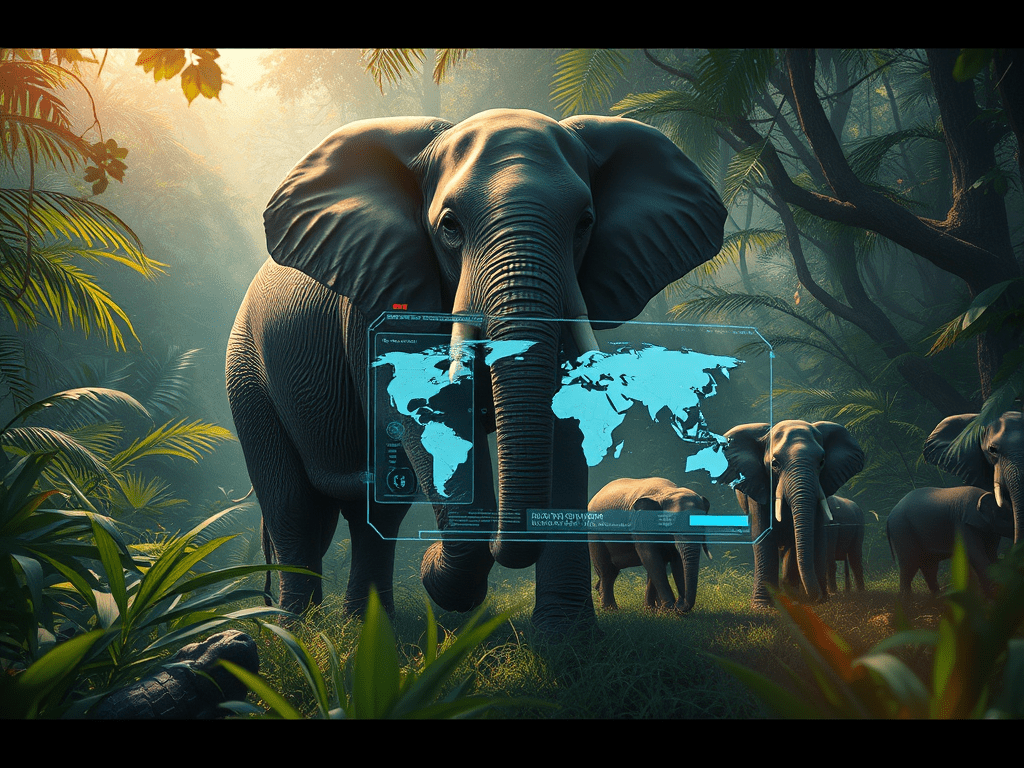
The Digital Battlefield: Why Conservation Needed a Reboot
For decades, the grim reality of wildlife conservation boiled down to a brutal, asymmetrical conflict: a handful of brave, often under-equipped rangers battling highly organized, heavily armed poaching syndicates across vast, unforgiving terrains. The odds were never in the animals’ favor. How can a dozen people patrol a national park the size of a small country? They can’t. The limitations of human surveillance—fatigue, visibility, and the sheer scale of the wilderness—created a poaching paradise.
The problem is fundamentally one of scale and immediacy. By the time a foot patrol found a carcass, the poachers were long gone, the evidence was cold, and another critically endangered animal was lost. The world needed a paradigm shift, an evolution from slow, reactive boots-on-the-ground to fast, proactive eyes-in-the-sky. Enter the unholy trinity of modern surveillance: smart drones, thermal sensors, and artificial intelligence-powered image recognition. This is not just an upgrade; it’s a total re-engineering of the global anti-poaching and species-monitoring effort.
The Eye in the Sky: Drones as Non-Negotiable Surveillance
Forget the hobbyist quadcopter. The drones being deployed across Africa’s savannas, Asia’s jungles, and South America’s rainforests are hardened, military-grade surveillance platforms, albeit repurposed for peace. They offer a simple, devastating advantage: persistence and reach.
A single drone, like those used by organizations such as Air Shepherd, can patrol a vast, multi-kilometer boundary for hours on a single charge. Crucially, they do this without leaving a scent trail, minimizing the disturbance to sensitive ecosystems.
But the real magic isn’t the flying—it’s the equipment they carry. Thermal cameras, or FLIR (Forward-Looking Infrared) sensors, are game-changers. Poachers are largely nocturnal, believing the cover of darkness is their shield. A thermal drone strips that illusion away. A human body radiates heat, a distinct signature against the cold night landscape. To the drone’s sensor, a poacher trying to sneak through the bush looks like a neon sign in a dark room. This capability allows rangers to see threats miles away, long before they can hear or see them, transforming a dangerous reaction into a planned, preemptive interception.
AI and Image Recognition as the Intelligence Core
A drone captures mountains of data—gigabytes of video and images. Processing that raw stream in real-time is impossible for a human operator, leading to what is often called “data overload.” This is where artificial intelligence steps in, transforming dumb footage into actionable intelligence.
AI-powered image recognition algorithms, often leveraging cutting-edge deep learning models like YOLO (You Only Look Once), are the conservationists’ new best friend. These systems are trained on massive datasets to recognize objects instantly. The process is lightning-fast and terrifyingly accurate:
- Species Identification: The AI can distinguish a rhino from a warthog, a lion from a tourist vehicle, or a baby orangutan’s nest from a clump of leaves. This provides accurate, non-invasive population counts for endangered species, giving scientists a real-time, high-fidelity census they could only dream of before.
- Anomaly Detection: More critically, the system is programmed to flag anomalies—specifically, human figures, vehicles, or suspicious tools in protected areas where they shouldn’t be. A real-time alert, complete with GPS coordinates, is sent directly to ranger teams.
- Behavioral Analysis: Beyond just counting, sophisticated models can track movement patterns, identifying unusual behavior that may indicate stress, illness, or a shift in habitat, thereby helping scientists understand the animals’ relationship with their changing environment.
One notable example is the use of AI on camera trap footage (a fixed-camera sensor system, a relative of the drone’s tech). Systems like TrailGuard AI are hidden, low-power cameras that use on-board AI to distinguish between an animal and a human, sending an immediate satellite alert only when a person is detected, drastically reducing false alarms and ensuring ranger response is immediate and targeted.
The Global Impact: From the Savanna to the Sea
This digital revolution isn’t confined to a single continent. It is a global conservation toolkit:
- In Africa’s Rhino Sanctuaries: Drones patrol the night, providing an invisible, lethal deterrent. The sight of a drone, or the knowledge that the sky is watching, has a measurable psychological impact, shifting the balance of power back toward the conservationists.
- Tracking Marine Life: Over the frigid waters of the South Atlantic, drones are now used to count penguin, whale, and seal colonies with unprecedented accuracy, often capturing samples (like “whale snot” for health analysis) without ever disturbing the animals.
- Monitoring Dense Forests: In the dense canopy of Southeast Asia, drones with LiDAR (Light Detection and Ranging) sensors can map habitat structure and track elusive species like orangutans by spotting their daily nests, providing crucial data for habitat protection and translocation efforts.
The Hard Truth: A Tech Solution is Not a Silver Bullet
While this technology is undeniably a monumental leap forward, it’s vital to inject a dose of ZME Science reality. Technology is not a panacea. The system remains reliant on several non-technical factors:
- Investment and Scale: This technology is expensive—the drones, the advanced sensors, the AI training, and the IT infrastructure required to process the data are a huge financial burden. Scaling this up for every park in the world is a massive, ongoing challenge.
- Regulatory Hurdles: Airspace restrictions, especially in politically sensitive regions, can severely limit drone flight, tying the hands of conservationists.
- Human Element: The most sophisticated AI alert system is useless if the ranger team on the ground can’t respond due to lack of vehicles, fuel, or backup. The tech must be an augment to human effort, not a replacement.
The bottom line is that smart drones and AI are shifting the fundamental metrics of the anti-poaching war. They are turning impossibly vast landscapes into manageable, surveilled territories. They are making data collection orders of magnitude faster and more accurate. Most importantly, they are tipping the scales, allowing rangers to meet the threat of poaching with surgical precision and speed. The poaching rings are adapting, but the scientists and conservationists now have an equally smart, perpetually vigilant eye on the planet’s most vulnerable creatures.





 Sure Media Magazine
Leave a comment