
By Vincent Bett
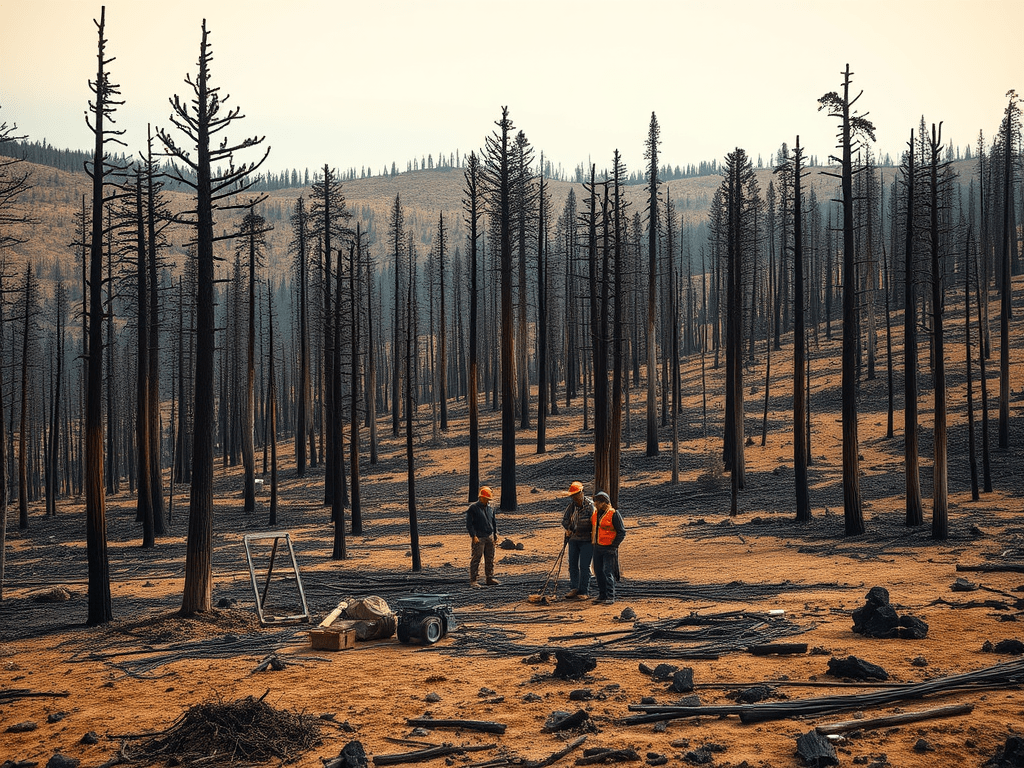
After the megafires that swept through Oregon’s Deschutes National Forest in 2020, much of the once vibrant ponderosa pine landscape was left charred and lifeless. Towering trunks stood like blackened sentinels over parched soil, their shadows stretching across ground so degraded that even hardy grasses refused to return. For years, reforestation crews struggled to coax new seedlings into the damaged earth. But in a quiet corner of the forest, a small group of scientists, rangers, and Indigenous fire practitioners may have found a way to help the land heal by turning its own waste into the very medicine it needs.
From Burnt Timber to Forest Healer
The solution lies in biochar, a carbon rich material produced by heating organic waste, such as logging slash and dead wood, in a low oxygen environment. The process locks carbon in solid form and creates a porous charcoal that, when mixed into soil, improves fertility, water retention, and microbial life.
At first glance, it sounds like simple chemistry. Yet in the context of the U.S. National Forest System, where millions of acres are suffering from repeated burns and thinning operations produce vast piles of leftover wood, biochar represents an elegant, circular solution. Instead of treating forest debris as waste or burning it in open piles, it can be repurposed into a regenerative tool that restores soil structure and resilience.
“We are essentially transforming a liability into a life support system,” says Dr. Laura Henson, a forest ecologist at Oregon State University leading trials across Deschutes and Klamath National Forests. “When biochar is applied to fire damaged soil, it not only stabilizes the terrain but also provides a foundation for native vegetation to recover.”
Measurable Impact on the Ground
Since 2021, Henson’s team has been running pilot projects funded jointly by the National Forest Foundation and local conservation groups. Using small, mobile kilns, they have processed pine waste directly on site, producing hundreds of cubic yards of biochar annually. Field measurements show encouraging results: soils treated with biochar retain up to 40 percent more moisture and support twice as many microbial species as untreated plots.
In one test zone near Sisters, Oregon, reforestation crews observed a 60 percent increase in seedling survival within a single growing season. “The soil comes back to life faster,” says Ranger Miguel Alvarez, who oversees restoration operations in the area. “Instead of fighting erosion year after year, we are seeing stable ground and young pines that actually stand a chance.”
The findings mirror similar efforts in Colorado’s Roosevelt National Forest, where biochar made from beetle killed timber has helped stabilize slopes and prevent post fire flooding. Together, these projects hint at a scalable path forward, one that bridges the gap between forest management and ecological restoration.
Challenges in Scaling Up
Despite its promise, biochar’s journey from field trial to large scale deployment faces significant hurdles. The most immediate is cost. Producing biochar requires specialized kilns and trained operators, and transporting heavy biomass to centralized facilities often cancels out the carbon and financial savings.
To overcome this, researchers are testing mobile pyrolysis units that can be deployed deep in the forest, powered by renewable energy sources. Another challenge is developing clear guidelines for how much biochar should be added to different soil types. Too little has minimal effect; too much can alter pH balance or disrupt native microbes.

“We are still learning how each forest responds,” says Henson. “The key is tailoring biochar composition to the local ecology rather than applying a one size fits all formula.”
A Tradition of Fire Reimagined
For Indigenous practitioners like Evan Talltree of the Confederated Tribes of Warm Springs, the technology also carries cultural resonance. His ancestors practiced controlled burning for centuries to maintain soil health and biodiversity. In many ways, biochar represents a continuation of that tradition fire used not to destroy, but to renew.
“When we burn intentionally, we honor the balance between taking and giving back,” Talltree explains. “Biochar is just a new way to speak that same language, one that combines science with our ancestral knowledge of the land.”
His team has begun collaborating with the Forest Service to integrate cultural burns and biochar production, ensuring that both ecological and traditional values guide restoration. “It is not just about fixing the soil,” he adds. “It is about restoring relationship between people, fire, and forest.”
The Science Behind the Solution
At its core, biochar works by creating a habitat for beneficial soil organisms. Its porous structure acts like a sponge, trapping water and nutrients while giving microbes and fungi a place to thrive. These organisms, in turn, help break down organic matter, fix nitrogen, and support root development.
The result is a soil ecosystem that recovers faster from trauma, a living network capable of holding carbon for hundreds of years. According to the U.S. Department of Agriculture, a single ton of biochar can sequester up to three tons of carbon dioxide equivalent over its lifetime. While Light & Seed avoids conventional “carbon capture” stories, this natural form of storage aligns with the magazine’s focus on biological innovation grounded in forest restoration, not industrial engineering.https://www.bioflux.earth/blog/what-is-biochar-carbon-removal#:~:text=Biochar%20can%20sequester%20between%202,years%20once%20integrated%20into%20soil.
The Path Forward
By mid-2025, the Oregon State University team plans to expand trials to Montana and northern California, where post fire landscapes are struggling with similar erosion and regeneration issues. The National Forest Foundation has expressed interest in incorporating biochar into its Reforestation Pipeline, a program that connects seedling production, nursery care, and site rehabilitation.https://biochar-us.org/biochar-potential-enhance-forest-resilience-seedling-quality-and-nursery-efficiency
If successful, the approach could shift how federal and community partners view forest waste: not as a burden to be disposed of, but as a renewable asset. “Every burned tree has the potential to feed new life,” says Alvarez. “That is the paradigm shift we are aiming for.”
Hope in the Ashes
Standing on a ridge overlooking a patch of recovering forest, Henson kneels to scoop a handful of soil darkened by biochar. It crumbles easily between her fingers, no longer sterile, but rich and breathing again. Around her, young pines sway in the wind, their needles catching sunlight where there was once only soot.
“This is the forest teaching us resilience,” she says. “It is showing that even after the most destructive fires, the ingredients for renewal are already here; we just have to learn how to use them wisely.”
As the U.S. faces a future of longer fire seasons and accelerating climate change, that lesson may prove to be one of the most valuable innovations of all.





 Sure Media Magazine
Leave a comment