
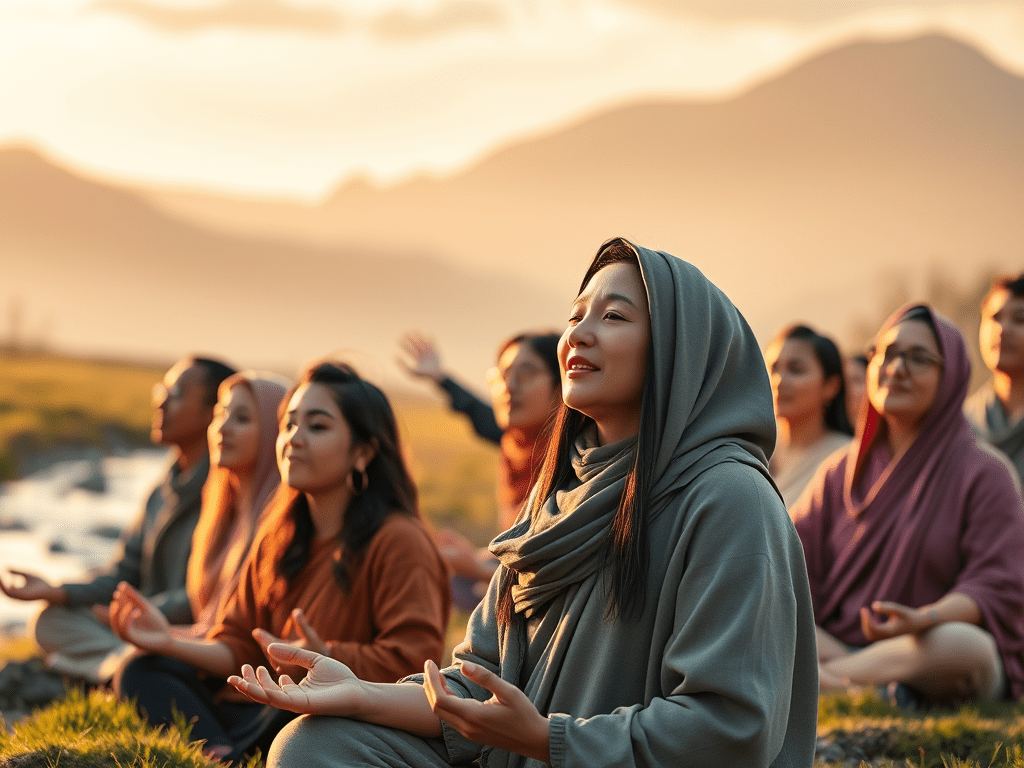
The world is drowning in connection yet starving for presence. As rates of anxiety and depression spiral into a global crisis; costing the global economy an estimated $1 trillion each year, the slick promises of Silicon Valley wellness and Big Pharma are increasingly falling short. The boldest revolution in mental health isn’t coming from a new app or a designer molecule; it’s being unearthed from antiquity.
The practices once relegated to monasteries, religious festivals, and ascetic retreats (Fasting, Chanting, and Pilgrimage) are now being rigorously stripped of their spiritual dogma and re-engineered in labs and clinics worldwide. They are being hailed as powerful, non-pharmacological interventions for a mind fractured by modernity. This is the Unplugged Revolution: a global, scientific validation of what our ancestors knew instinctively.
Fasting: From Religious Discipline to Neuro-Metabolic Reset
For millennia, fasting has been a spiritual cornerstone, a discipline for purification and heightened consciousness, from the Islamic observance of Ramadan to the Christian tradition of Lent. Today, this ancient practice of self-denial has been secularized into Intermittent Fasting (IF) and Time-Restricted Eating (TRE), not for the soul, but for the brain.
The science is stark and compelling. Clinical studies are showing that fasting does more than just control weight; it triggers a profound neuro-metabolic shift. When the body switches from burning glucose to burning ketone bodies (a byproduct of fat breakdown), a cascade of anti-inflammatory and antioxidative effects is unleashed. This is critical because chronic low-grade inflammation is increasingly implicated in mental health disorders.
A systematic review and meta-analysis found that fasting interventions led to measurably lower anxiety and depression levels in study groups. The magic, it seems, lies in the brain’s ability to adapt. Research using fMRI has shown that TRE; a common form of IF, reduced anxiety by changing the functional connectivity of the amygdala, the brain’s fear and stress center. The neurobiological hypothesis is that fasting promotes cognitive resilience and brain plasticity, possibly by activating the hypothalamic-pituitary-adrenal (HPA) axis and altering neurotransmitters like serotonin.
The global shift sees fasting moving from an optional diet trend to a clinically investigated adjuvant therapy. It’s the ultimate bio-hack rooted in ancient survival, where a temporary, controlled absence sparks a durable, positive internal resource. However, its adoption demands caution: the conflicting results on mood (with some studies reporting initial irritability) mean professional guidance is non-negotiable, particularly for individuals with existing psychiatric conditions.
Chanting: The Universal Vibration of Emotional Regulation
The rhythmic, often melodic repetition of a sound, word, or phrase; be it the Vedic ‘Om’, the Buddhist ‘Namo Amida Butsu’, or the Gregorian Chant, is a practice found in nearly every world culture. This is the ancient art of mantra, now stripped of its Sanskrit or Latin roots and reinterpreted as a sophisticated tool for emotional regulation and attentional control.
Contemporary psychological research views chanting not as a prayer but as a focussed mindfulness practice. The power lies in its rhythmic and repetitive nature, which forces the mind away from the endless loop of negative self-talk, often referred to as the Default Mode Network (DMN) activity. By giving the mind a single, simple, repetitive task, chanting effectively de-activates the pre-frontal regions associated with rumination, cultivating a state of calm and clarity.
A study evaluating the secular benefits of mantra chanting found a significant link to improved cognitive resilience; the ability to cope well with stress and adverse situations. The continuous vocalization, often linked to paced breathing, can induce a “relaxation response” that lowers heart rate and blood pressure, mirroring the effects of deep meditation.
In a hyper-distracted world, the power of a simple, repeated sound; be it a traditional mantra or a modern, secular affirmation, is its absolute simplicity and accessibility. It’s an “in-vivo” therapy that requires no special equipment, just a breath and a voice. Chanting is a profound, global example of how sound-based techniques are being integrated into wellness programs and even trauma recovery, demonstrating a culturally-embedded, inexpensive intervention for the global mental health challenge.
Pilgrimages: The Long Walk Back to Self-Efficacy
A pilgrimage is traditionally a sacred journey to a holy place; Mecca, Jerusalem, or Santiago de Compostela. But a massive, growing trend is the secular pilgrimage: the long-distance walk undertaken for emotional, psychological, or existential reasons rather than religious ones. The Camino de Santiago, for instance, is now traversed by thousands annually seeking a mental reset, a life-altering decision, or healing from grief.
Psychologists and anthropologists are analyzing this global phenomenon, finding that the profound mental health benefits of the pilgrimage lie in a few key components:
- The Monastic Routine: Long-distance walking imposes a simple, repetitive daily routine. The only goals are shelter, food, and forward movement. This reduction in complex decision-making provides an intense psychological rest from the overload of modern life, allowing the pre-frontal cortex to relax.
- Solvitur Ambulando (It is solved by walking): The rhythmic, bilateral movement of walking is similar to practices like Eye Movement Desensitization and Reprocessing (EMDR), which can aid in processing traumatic memories. Furthermore, physical exertion releases endorphins and endocannabinoids, natural mood-boosters. The intentional hardship fosters a deep sense of self-efficacy and accomplishment.
- Community and Detachment: The pilgrim exists in a temporary, supportive micro-community (often with strangers), countering the modern epidemic of loneliness. Simultaneously, the sustained time alone with one’s thoughts, disconnected from digital noise, is a forced meditation on self-reflection and personal meaning.
The modern pilgrim’s journal is less about divine intervention and more about cognitive reframing. The blisters, the cold, the sheer difficulty; these become metaphors for life’s struggles, and overcoming them proves a potent narrative of resilience. The journey is not just a walk to a place; it’s a journey through a life phase, culminating in a concrete, tangible feeling of transformation that clinical therapy often struggles to provide.
The Verdict: Decolonizing the Mind
The bold reinterpretation of these ancient practices signals a fundamental, global shift away from a purely pathologizing, Western-centric model of mental health. It’s an act of decolonizing the mind, recognizing that practices rooted in human spiritual and communal needs hold quantifiable physiological and psychological power.
We are entering an era where ancient wisdom and modern neuroscience are converging, creating a powerful, accessible, and globally relevant toolkit for mental well-being. The challenge now is to respectfully and ethically integrate these secularized techniques into mainstream, rights-based mental health care, making them available not just to the privileged few, but to the over one billion people globally living with a mental health condition. The path to a more present, resilient mind might not be forward into the digital ether, but backward, into the powerful stillness of ancient disciplines.





 Sure Media Magazine
Leave a comment