
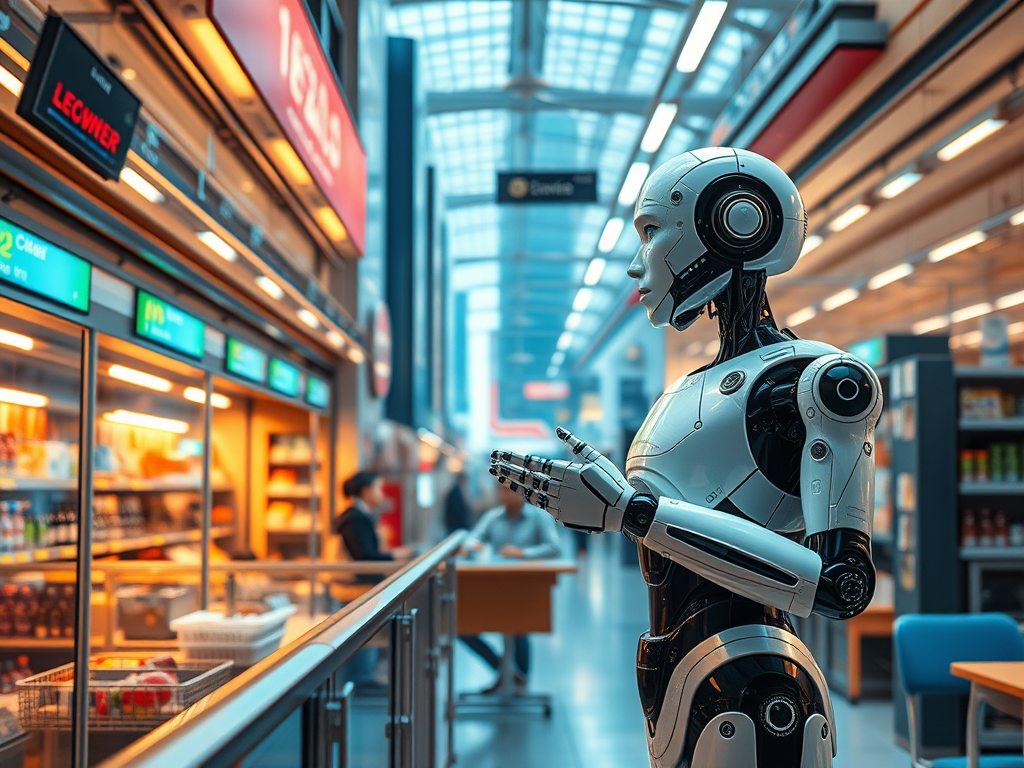
We are living in a moment of history where the lines between man and machine are no longer clear.
Artificial Intelligence is no longer a futuristic concept locked away in labs or tech hubs. It is already part of our daily lives, shaping how we work, learn, create, and connect. Some fear it. Others worship it.
But perhaps the most powerful response lies somewhere in the middle: in understanding it deeply, accepting its impact, and learning how to thrive alongside it.
The “Replacement” Reality
It is true that AI is replacing human roles. This is not a theory or a prediction anymore; it is already happening. The International Monetary Fund (IMF) recently reported that AI is expected to affect nearly 40% of jobs globally.
Walk into a supermarket and you will see self-checkout machines instead of cashiers. Call a customer care line and chances are, you will speak to a chatbot instead of a human. This isn’t just a feeling; it’s a clear trend. Projections show that by 2025, as many as 80% of customer service roles could be handled by AI.
Many have already felt the shift:
- Writers
- Graphic designers
- Transcribers
- Translators
- Data entry clerks
Jobs that are repetitive, rule-based, and predictable are being handled more quickly and cheaply by machines. That’s just how technology evolves. From the loom to the printing press to the personal computer, every leap in technology has left some roles behind. The World Economic Forum (WEF) estimates that technology and automation will displace 85 million jobs globally by 2025.
But that is only one side of the coin.
The “Assistance” Flip Side
There is another reality, just as powerful: AI is also an incredible assistant.
It does not seek to destroy human value, but to multiply it. In fact, McKinsey’s 2025 “State of AI Report” found that 71% of organizations are now using AI, reporting an average return on investment of $3.70 for every $1 invested.
- It allows doctors to diagnose with higher accuracy. A 2024 NIH study confirmed this, showing AI assistance increased diagnostic accuracy for clinicians by 4.4%.
- It helps teachers personalize lessons for each student.
- It allows entrepreneurs to launch businesses faster, creators to publish content with professional polish, and students to study smarter, not harder. This is backed by surveys where 90% of workers reported that AI saves them time, freeing them to focus on what matters.
AI is not just a competitor, it is a partner, a tool, a bridge to higher potential. And just like fire, it can either burn or warm, depending on how you handle it.
The truth is that AI will both assist and replace. The jobs most vulnerable are those that refuse to adapt. But for those willing to learn, evolve, and embrace this new era, AI is not the enemy. It is a gift.
How to Become Irreplaceable
The question then shifts from “Will I be replaced?” to “How can I become irreplaceable?”
The most irreplaceable qualities are still human.
- Empathy
- Intuition
- Ethics
- Creativity
- Contextual intelligence
AI cannot feel. It cannot care. It cannot understand the complexities of culture, compassion, or character. That means you still have something AI will never have: the human touch.
These qualities cannot be coded into a machine. Even the most advanced AI cannot comfort a grieving family, negotiate peace between conflicting parties, or lead with compassion. Machines can calculate and generate, but they cannot care.
The Future is About Adaptation, Not Fear
So yes, AI will take over some jobs. But it will also create new ones. The World Economic Forum, in the same report that cited 85 million job losses, forecasted the creation of 97 million new roles by 2025—jobs built for an era of human-AI partnership.
These are roles that require new combinations of skills: tech and humanity, data and storytelling, speed and empathy. People who learn to harness AI will not just survive this revolution, they will lead it.
To do that, we must let go of fear and step into learning. You do not need to be a programmer to work with AI. You only need curiosity, humility, and a willingness to grow. Learn how it works. Experiment with it. Let it support you in your craft.
This isn’t just a hopeful thought. The WEF’s 2025 “Future of Jobs” report explicitly names “creative thinking,” “adaptability,” “resilience,” and “curiosity” as some of the fastest-growing skills in demand. Let AI handle the repetitive so you can focus on the meaningful. Use it to stretch your capacity, not shrink your identity.
It’s Not About AI, It’s About You
In the end, it is not really about AI. It is about us. Our willingness to adapt. Our courage to explore. Our decision to use this tool not just for efficiency, but for impact.
This is not about fearing AI. It’s about choosing how you respond to it.
Because while AI will replace those who resist change, it will elevate those who embrace it.
AI will assist. AI will replace. But more importantly, it will reveal. It will reveal who is prepared and who is not. Who is willing to grow and who is waiting for things to go back to “normal.” The future does not belong to AI. It belongs to those who know how to use it. And that future is already here: data shows that workers with specialized AI skills are already earning wages that are, on average, 25% higher than their peers in similar roles who do not possess those skills.
And that can be you.
What is one way you’ve started using AI in your own life or work?





 Sure Media Magazine
Leave a comment