
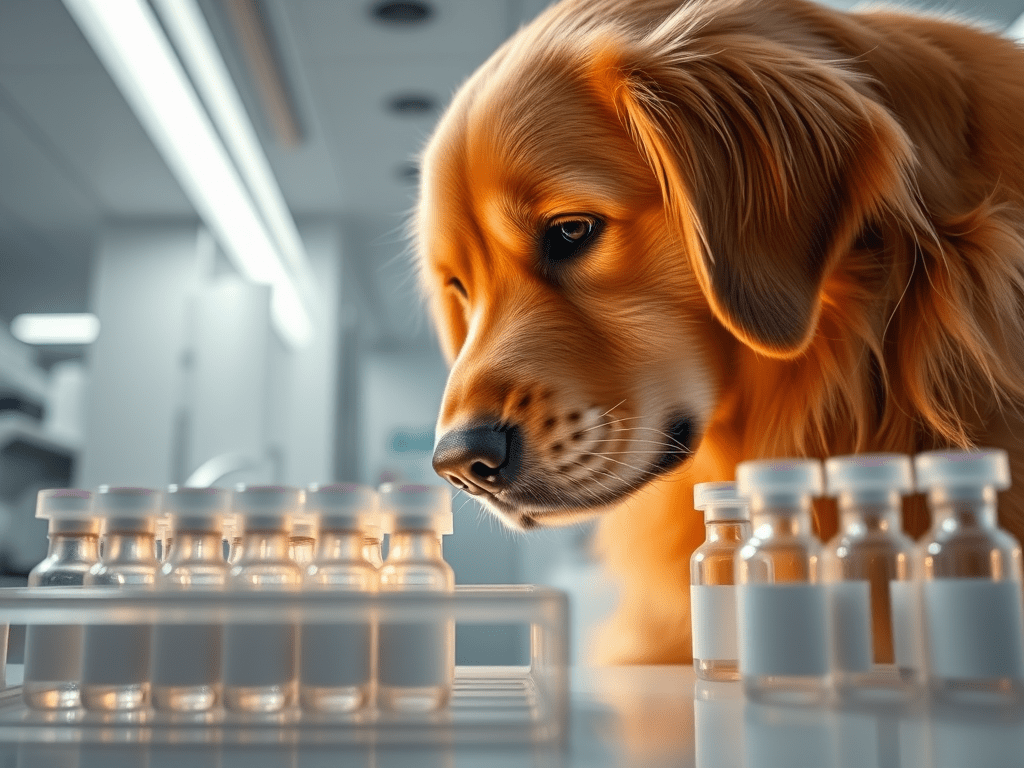
In the sterile hush of a hospital lab, fluorescent lights hum like distant cicadas. A golden retriever named Maple glides forward. Her amber coat catches the glow as she lowers her velvet muzzle over a tray of sealed vials. The air seems empty to human lungs—yet her nostrils flare, drinking in invisible rivers of molecules. A single whisker trembles. One paw lifts, hovers, then folds beneath her as she sits with quiet certainty. A technician’s screen flashes green: cancer confirmed. For decades, machines claimed dominion over diagnosis. Maple just rewrote the rulebook with a wagless tail.
No Microscope
From shadowy tumors blooming in silent organs, dogs detect scents no microscope can map. They sense the electric spike of a diabetic’s blood sugar. Three hundred million olfactory receptors—versus our paltry six million—turn each breath into a symphony of volatile whispers. These chemical ghosts, exhaled by diseased cells, drift at concentrations measured in parts per trillion. This article follows the dogs, trainers, and scientists translating those whispers into lifesaving alerts. They grapple with the ethics of turning living noses into diagnostic instruments.
The Science Behind the Sniff
Imagine a cathedral built inside a skull. The canine olfactory epithelium unfurls like a crimson scroll. It is 100 times larger than ours compared to body size. Air surges through labyrinthine turbinates, each fold a chemical fingerprint scanner. In the brain’s scent cortex, neurons ignite in kaleidoscopic patterns. They decode tumorous terpenes, bacterial bouquets, or the sour tang of hypoglycemia. This happens before blood tests whisper a clue.
Under the glare of double-blind trials, dogs stride past rows of identical jars. A lung-cancer sample releases a faint plume of benzene derivatives; the dog freezes, tail rigid as a metronome. A 2019 study found three beagles achieving 97% accuracy. They distinguished blood serum samples from patients with non-small cell lung cancer versus healthy controls. This was after eight weeks of training in a double-blind setup. Another 2023 study on exhaled breath samples reported sensitivity of 91.7% and specificity of 85.1% for lung cancer detection. Six trained dogs were used. They showed higher detection rates when trained directly on breath rather than tissue samples. For prostate cancer, a 2021 study showed dogs detecting Gleason 9 cases with 71% sensitivity and 73% specificity. Dr. Pamela Dalton, silhouetted against glowing chromatographs at the Monell Chemical Senses Centre, isolates the same compounds in glass vials. “We’re chasing ghosts the dogs already shake hands with,” she says, eyes alight.
Training and Technique
Dawn on a dew-drenched field: Amanda Lee kneels, clicker poised like a conductor’s baton. Maple’s ears swivel. A target scent—prostate cancer frozen in a cotton swab—hides among twenty decoys. Positive reinforcement crackles: sniff, alert, jackpot of liver treats raining like confetti.
Inside a diabetic’s living room, a black Lab named Juno identifies the scent of plummeting glucose. It is a sharp, metallic note beneath the skin’s warmer bouquet. She paws her owner’s thigh at 2 a.m., breath fogging the moonlight. The glucometer confirms: 62 mg/dL and falling. A 2019 review of 27 diabetic alert dogs found a median sensitivity of 83% for hypoglycemic episodes. It found 67% for hyperglycemic ones. The overall positive predictive value was 81%, based on nearly 4,000 owner-reported out-of-range events. “It’s a duet,” Lee murmurs, fingers buried in Juno’s ruff. “Her nose, my trust.”

Ethical and Practical Considerations
Picture a detection dog in a bustling airport: fluorescent vests, rolling suitcases, the metallic tang of anxiety. How many sweeps before fatigue dulls the spark? Handlers track heart rates via biometric collars; sessions cap at twenty minutes, followed by zoomies in a sunlit paddock.
In labs, false positives are dissected like rare specimens. Was it stress? A rogue perfume? Protocols bloom: double verification, scheduled sabbaticals, retirement to couch-potato glory. “They’re not equipment,” a veterinarian insists, brushing kibble from a grey muzzle. “They’re colleagues with cold noses and warm hearts.”
Real-World Impact
A pediatric ward at dusk: a child’s laughter rings as a springer spaniel noses a urine sample. Sit. The oncologist’s shoulders drop—ovarian cancer caught at stage I.
At border crossings, Belgian Malinois weave through crowds. Their tails are low as their nostrils map the sour signature of COVID-19 on breath and sweat. One alert, one swab, one life rerouted from ICU to quarantine. A 2023 study demonstrated dogs achieving 97% accuracy in detecting COVID-19 from sweat samples of 335 people. This includes asymptomatic cases. They often detect infection up to 48 hours before PCR tests.
In homes, diabetic alert dogs curl like living stethoscopes, ears tuned to the body’s secret music. Their warnings arrive not as beeps but as gentle head-butts against a sleeping cheek.
The Future of Canine Diagnostics
Envision a triage tent in a remote village. A dog screens exhaled breath. Positive alerts trigger a $5 rapid test. This is instead of a $5,000 scan. Meanwhile, engineers at MIT mold silicon “noses” etched with canine-inspired receptor arrays, each polymer tendril quivering at parts-per-quadrillion.
Dr. Dalton holds a prototype sensor beside Maple’s snout. “She’s the blueprint,” she laughs as the dog sneezes on the gadget. “We’re just trying to catch up.”
This isn’t merely about pets with prodigies. It’s a portal to a future where biology and silicon interact. A wet nose and a microchip share the same heartbeat.

The Bottom Line
Next time a dog buries its muzzle in your palm or pauses mid-sniff at a stranger’s knee, picture the unseen. Imagine rivers of scent cascading through ancient architecture. They map illness in brushstrokes no screen can render. Behind those liquid eyes burns a superpower older than medicine itself. It could rewrite the story of human survival, one breath at a time.




 Sure Media Magazine
Leave a comment