
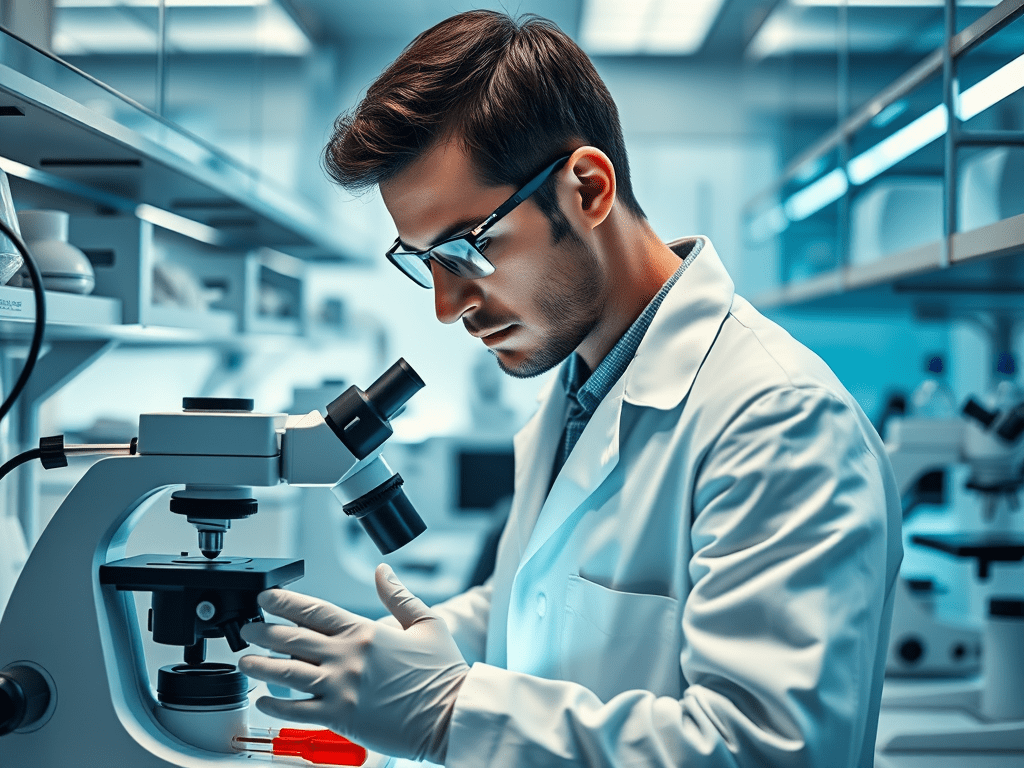
You will remember the face of the physician who gave you the news. You recall the nurse who administered your treatment. But you will never meet the individual. This person spent years in rigorous training to generate the critical data that made your care possible. As a Medical Laboratory Scientist, I work in the silent, humming heart of the hospital. This is a place of calibrated machines and focused concentration. Here, we translate the body’s secrets into actionable truth.
My role is a triad of immense responsibility:
- The Science: We are not just button-pushers. We are experts in hematology, microbiology, immunology, and molecular diagnostics. We understand the complex patho-physiology behind every abnormal result. We know that a bizarre-looking cell under the microscope is leukemia. A specific genetic mutation dictates a life-saving, targeted therapy.
- The Precision: There is no room for “close enough.” A decimal point in the wrong place on a potassium level can mean the difference between life and death. A misidentified bacterium can lead to a futile course of antibiotics. We are the guardians of accuracy. We carry out intricate calibrations and run countless controls. We adhere to a rigid dogma of procedure to guarantee every result we release is unassailable.
- The Responsibility: The phone call at 3 AM isn’t an interruption; it’s a mission. A “critical value”—like a plummeting platelet count or a sky-high troponin—isn’t just a number on a screen. It’s a patient crashing in the ER. It’s a mother in labor on the 4th floor. It’s a grandfather on the oncology ward. We are the silent sentinels, the ones who sound the alarm that mobilizes an entire healthcare team.
My world is one of quiet vigilance. It’s the hum of the centrifuge. It’s the glow of the bio-safety cabinet. The intense focus is needed to differentiate between similar-looking parasites on a blood smear. Troubleshooting a flawed analyzer result is like solving an intellectual puzzle. It combines the detective’s deductive reasoning with the engineer’s technical skill.
Healthcare is accelerating into a new era of personalized medicine. Our laboratories are not just keeping pace. I am leading the charge. This evolution demands that I:
✅ Integrate Advanced Technology and AI: I am moving beyond automation to intelligence. AI algorithms can now scan digital pathology slides for cancerous cells with superhuman speed. Machine learning helps me discover subtle patterns in flow-cytometry data. These patterns can be missed by the human eye. My role is evolving to manage, interpret, and confirm these powerful tools.
✅ Forge Unbreakable Quality Systems: In a world of rapid results, safety is non-negotiable. I am building multi-layered quality systems—from daily precision checks to external skill testing—that create a safety net for every patient. This relentless pursuit of quality is my ethical compact with the public.
✅ Become Clinical Collaborators, Not Just Service Providers: The most significant shift is moving from the basement lab. It extends to the virtual bedside. I am building bridges with clinical teams. I make certain that my data is not just a number in a chart. It becomes a meaningful part of the patient’s story. A Pharmacist calls to discuss a surprising drug level; I explain the metabolic interaction. A Surgeon questions a coagulation panel before a procedure; I help them interpret the nuances. I am becoming diagnostic consultants, the hidden physicians of the clinical team.
So, here’s to the laboratorians. To the one who cross-matched the blood for your emergency surgery. To the one who cultured the bacteria from your infection and found the one antibiotic it couldn’t resist. To the one who ran the genetic test. This test identified the specific mutation for your rare disease. It finally ended your diagnostic odyssey.
I am the unseen. I am wear lab coats instead of scrubs, and my stethoscope is the microscope. I never meet you. Your diagnosis is my handwriting. Your treatment is guided by my data. Your well-being is the absolute focus of my silent, essential science.





 Sure Media Magazine
Leave a comment