
Introduction
Picture this: A smallholder farmer in Kenya checks her phone. A simple alert warns her: “Below-average rainfall expected for the next 6 weeks.” This isn’t a guess. It’s a data-driven insight. It allows her to plant drought-resistant crops, safeguarding her family’s livelihood and her community’s food supply.
Here’s the problem: For decades, understanding our climate felt like trying to drink from a firehose. We’re drowning in data—from satellites, weather stations, and ocean buoys—but starved for clear, actionable insights. The data is too big, too messy, and too scattered to be useful in time.
So, what’s the solution? The same powerful tech trends revolutionizing e-commerce and fintech are now being deployed to save our planet. Data pipelines and Artificial Intelligence (AI) are the dynamic duo, finally turning the chaotic flood of climate data into a steady stream of life-saving intelligence.
Let’s break down how.
The Data Deluge: Why Climate Data is a nightmare.

Climate data is the ultimate “big data” challenge. It’s not just one problem; it’s three rolled into one.
Volume: Satellites alone generate terabytes of images every single day. Traditional servers simply can’t cope.
Variety: Data comes in countless formats—numerical readings from sensors, image files from space, text-based historical records. Getting them to “talk” to each other is a huge headache.
Velocity: Climate systems change in real-time. A model that takes weeks to run is useless for predicting a hurricane that will make landfall in 48 hours.
Without modern tools, scientists spend up to 80% of their time just cleaning and organizing data. That’s time not spent on finding solutions. This delay is a critical problem, especially in regions like the Sahel, where advancing desertification requires swift, data-backed action.
The Unsung Hero: The Data Pipeline
Think of a data pipeline as an automated, super-efficient factory assembly line for data. Its sole job is to take raw, messy information from countless sources and reliably transform it into a clean, usable product.
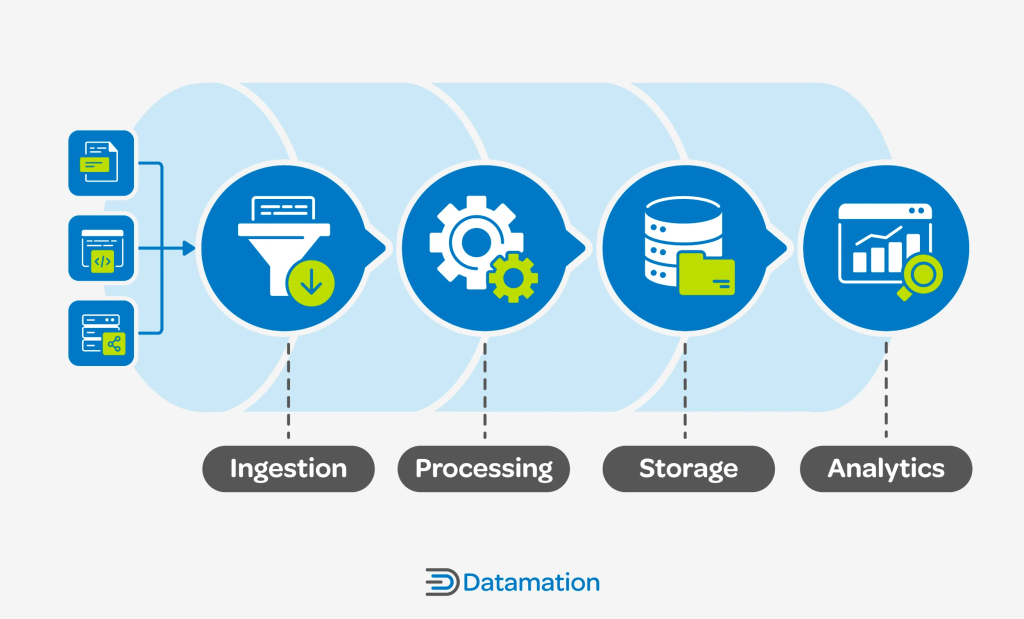
How does this work in practice?
1. Ingestion: The pipeline automatically pulls in data from NASA satellites, IoT weather stations in Nigeria, and historical rainfall databases from the African Centre of Meteorological Applications for Development (ACMAD).
2. Cleansing & Validation: It filters out errors—like a faulty sensor reading from a dusty station—and intelligently fills in missing gaps.
3. Unification: It merges these different data streams, creating a single, coherent picture of the climate.
4. Delivery: Finally, it serves this clean, prepared data to storage systems or, crucially, directly into AI models ready for analysis.
This automation frees up experts to do what they do best: analyze and innovate.
The Brainpower: AI’s Climate IQ
If data pipelines are the nervous system, AI is the brain. Machine Learning models are essential in identifying patterns in massive datasets that are impossible for humans to see.

Here’s AI in action:
Predicting Extreme Weather: AI models can analyze ocean temperature and atmospheric pressure data to detect the early, faint signals of a forming cyclone in the Indian Ocean, giving coastal communities in Mozambique and Tanzania critical extra days to prepare.
Hyperlocal Forecasting for Agriculture: Global climate models are too broad. AI can “downscale” them, turning a continental forecast into a precise, village-level rainfall prediction. This is the tech behind the alert our Kenyan farmer received.
Monitoring Environmental Health: In Lagos or Nairobi, AI can analyze data from a network of low-cost air quality sensors, identifying pollution hotspots in real-time and guiding urban planning decisions.
Case Studies: The Tech in Action
Let’s move from theory to real-world impact.
1. Aerial Intelligence for African Agriculture
The Tech: Startups like Aerobotics in South Africa use data pipelines to process drone and satellite imagery. AI models then analyze this data to count individual trees, assess crop health, and predict yields for fruit farms.
The Impact: A macadamia farmer gets a dashboard showing exactly which trees are stressed by water shortage, allowing for precision irrigation that saves water and boosts harvests.
2. Beating drought with Data in Kenya
The Tech: The Kenya Agricultural Carbon Project (and others) uses data pipelines to aggregate soil, weather, and satellite data. AI helps model the impact of certain farming practices on soil carbon and water retention.
The Impact: Farmers are advised on techniques that make their land more resilient to drought. Their improved yields are a direct result of data-driven insights.
3. Breathing easier in Urban Africa
The Tech: Initiatives like AirQo in Uganda deploy a network of custom-built, low-cost air quality monitors. Data pipelines collect this real-time information, and AI helps fill data gaps and create high-resolution pollution maps of Kampala.
The Impact: Citizens can use an app to check daily air quality, and city officials can use the data to inform public health policy and track pollution trends.
The Future is a Collaborative Dashboard
The next wave is the seamless fusion of pipelines and AI.
Real-Time Climate Dashboards: Imagine a national dashboard for a country like Malawi, combining live satellite data, river level sensors, and AI-predicted flood paths to coordinate emergency response.
Explainable AI (XAI): Building trust is key. XAI will help models show their “working out,” so a meteorologist can see why the AI predicts a drought, not just that it does.
The Open Data Movement: The real acceleration will come from collaboration. Open-source datasets and tools from NASA, Copernicus, and African institutions are inviting a global brain trust to solve these challenges.
Your Skills are the missing pieces

Climate change isn’t just a science problem; it’s the world’s most critical data and engineering challenge.
Data Engineers: Your ability to build robust, scalable pipelines is the backbone of every system we’ve discussed.
AI/ML Specialists: The patterns hidden in climate data are a perfect playground for your predictive models.
Developers & Analysts: You build the dashboards, APIs, and visualizations that turn complex data into tools a farmer or city planner can actually use.
This is a chance to work on a purpose-driven project that also hones your skills in cutting-edge tech.
Ready to Build?
Lines of code, clean data, and smart algorithms will win the fight against climate change. You don’t need to be a climate scientist to make a difference; you need to be a curious techie.
Here’s how you can start today:
1. Explore Open Data: Go to the Copernicus Climate Data Store or NASA’s Worldview. Download a dataset on African rainfall or temperature. Get a feel for the data.
2. Build a Mini-Pipeline: Use a tool like Apache Airflow or Prefect to create a simple pipeline for fetching and processing daily air quality data from a public API.
3. Build a Simple Model: Start with a Kaggle dataset on historical weather and create a basic model to predict next-day temperatures. Begin small, test, and improve as you go.
4. Join Forces: Explore hackathons or open-source projects in climate tech, especially those focused on Africa. Your contribution and perspective can make a real difference.
A global network of tech professionals who step up to act will shape the future of climate resilience. Your skills are part of the solution. Let’s create those solutions together.





 Sure Media Magazine
Leave a comment