
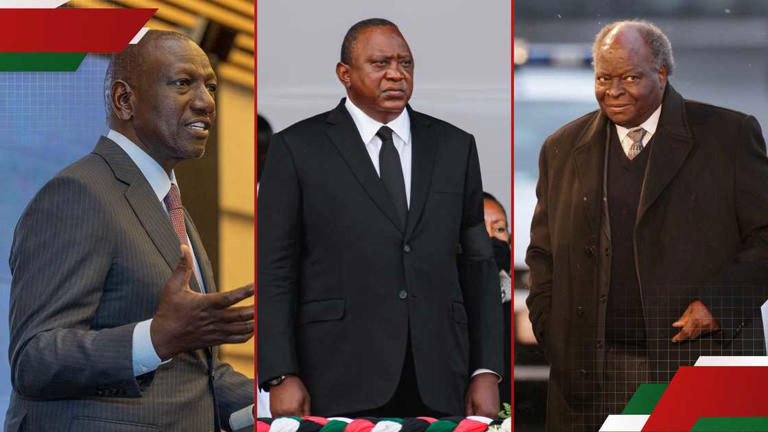
This report provides a detailed comparison of the economic performance during the first three years of the presidencies of Mwai Kibaki (2003–2005), Uhuru Kenyatta (2013–2015), and William Ruto (2022–2024).
The analysis focuses on key economic metrics: GDP growth, inflation rates, unemployment figures, stock market performance, and additional indicators like public debt and fiscal deficit.
Data is sourced from reputable institutions such as the World Bank, Kenya National Bureau of Statistics (KNBS), and other financial databases. Note that some data, particularly for unemployment and stock market performance, is limited or inconsistent due to historical record availability or methodological differences.
Methodology
The analysis uses annual data for each president’s first three years in office:
- Mwai Kibaki: December 30, 2002, to December 30, 2005 (data for 2003–2005).
- Uhuru Kenyatta: April 9, 2013, to April 9, 2016 (data for 2013–2015).
- William Ruto: September 13, 2022, to July 4, 2025 (data for 2022–2024, with 2024 as an estimate).
Metrics are evaluated using data from the World Bank, MacroTrends, World Data, and other sources. Where data is unavailable (e.g., stock market indices for early years), proxies like equity turnover are used. Unemployment figures are treated cautiously due to potential underreporting in Kenya’s informal economy. Scroll to the bottom to see the source list.
Economic Metrics Comparison
GDP Growth
GDP growth reflects the annual percentage increase in real GDP, indicating economic expansion.
| President | Year | GDP Growth Rate (%) | Source |
|---|---|---|---|
| Kibaki | 2003 | 2.93 | MacroTrends |
| Kibaki | 2004 | 5.10 | MacroTrends |
| Kibaki | 2005 | 5.91 | MacroTrends |
| Kenyatta | 2013 | 5.88 | World Bank |
| Kenyatta | 2014 | 5.36 | World Bank |
| Kenyatta | 2015 | 5.72 | World Bank |
| Ruto | 2022 | 4.85 | MacroTrends |
| Ruto | 2023 | 5.60 | World Bank |
| Ruto | 2024 | 4.50 (est.) | World Bank |
Analysis:
- Kibaki: GDP growth improved from 2.93% in 2003 to 5.91% in 2005, reflecting recovery from the economic stagnation of the 1990s. Reforms like the establishment of the National Debt Management Department and Kenya Revenue Authority (KRA) enhancements boosted revenue and infrastructure investment.
- Kenyatta: Growth was robust, averaging 5.65%, driven by infrastructure projects and a stable global economy. The 2013 election transition boosted investor confidence, contributing to higher growth.
- Ruto: Growth ranged from 4.5% to 5.6%, with 2024 being an estimate. Despite global shocks (e.g., commodity price volatility), the economy showed resilience, though growth slowed in 2024 due to fiscal consolidation and protests.
Inflation Rates
Inflation is measured as the annual percentage change in the Consumer Price Index (CPI).
| President | Year | Inflation Rate (%) | Source |
|---|---|---|---|
| Kibaki | 2003 | 9.80 | World Data |
| Kibaki | 2004 | 11.80 | World Data |
| Kibaki | 2005 | 9.90 | World Data |
| Kenyatta | 2013 | 5.70 | World Data |
| Kenyatta | 2014 | 6.90 | World Data |
| Kenyatta | 2015 | 6.60 | World Data |
| Ruto | 2022 | 7.60 | World Data |
| Ruto | 2023 | 7.70 | World Data |
| Ruto | 2024 | 5.10 | World Data |
Analysis:
- Kibaki: High inflation (9.8%–11.8%) was driven by economic adjustments post-2002 elections and global oil price increases. By 2005, inflation stabilized slightly.
- Kenyatta: Lower inflation (5.7%–6.9%) indicates effective monetary policy and stable economic conditions. The Central Bank’s policies helped anchor inflation expectations.
- Ruto: Inflation peaked at 7.7% in 2023 due to global commodity price shocks but fell to 5.1% in 2024, reflecting tighter monetary policy and easing global pressures .
Unemployment Figures
Unemployment rates represent the share of the labor force without work but seeking employment.
| President | Year | Unemployment Rate (%) | Source |
|---|---|---|---|
| Kibaki | 2003 | 2.87 | MacroTrends |
| Kibaki | 2004 | 2.85 | MacroTrends |
| Kibaki | 2005 | 2.75 | MacroTrends |
| Kenyatta | 2013 | 2.76 | MacroTrends |
| Kenyatta | 2014 | 2.77 | MacroTrends |
| Kenyatta | 2015 | 2.76 | MacroTrends |
| Ruto | 2022 | 5.71 | MacroTrends |
| Ruto | 2023 | 5.57 | MacroTrends |
| Ruto | 2024 | 5.43 | MacroTrends |
Analysis:
- Kibaki: Low official unemployment rates (2.75%–2.87%) likely understate true unemployment due to Kenya’s large informal sector. Data may not capture underemployment or youth unemployment, estimated at nearly 40% for ages 18–34.
- Kenyatta: Similarly low rates (2.76%–2.77%) suggest data limitations. Economic growth created jobs, but quality and accessibility remained challenges, particularly for youth.
- Ruto: Higher rates (5.43%–5.71%) may reflect improved data collection or economic pressures from global shocks. Youth unemployment remains a concern, with 2023 estimates at 12.23% for ages 15–24.
Stock Market Performance
Stock market performance is assessed using the Nairobi Securities Exchange (NSE) 20 Share Index or equity turnover where index data is unavailable.
| President | Year | Stock Market Metric | Value | Source |
|---|---|---|---|---|
| Kibaki | 2003 | Equity Turnover (KSh billion) | 15.25 | Wikipedia |
| Kibaki | 2004 | Equity Turnover (KSh billion) | 22.32 (46.37% increase) | Wikipedia |
| Kibaki | 2005 | Equity Turnover (KSh billion) | 36.52 (63.61% increase) | Wikipedia |
| Kenyatta | 2013 | Stock Market Return (%) | 50.02 | The Global Economy |
| Kenyatta | 2014 | NSE All Share Index (points) | 166 | SSBFNET |
| Kenyatta | 2015 | NSE All Share Index (points) | 156 | SSBFNET |
| Ruto | 2022 | NSE 20 Index (points) | 1679.1 (Dec 31) | CEIC Data |
| Ruto | 2023 | NSE 20 Index (points) | 1500.5 (Dec 31) | CEIC Data |
| Ruto | 2024 | NSE 20 Index (points) | 2300.2 (Feb 2025) | CEIC Data |
Analysis:
- Kibaki: Significant growth in equity turnover (15.25 billion KSh in 2003 to 36.52 billion KSh in 2005) indicates a vibrant market, driven by reforms and increased investor confidence. The NSE 20 Share Index existed, but historical values are unavailable.
- Kenyatta: A 50.02% return in 2013 reflects strong market performance, likely due to post-election optimism. The NSE All Share Index rose to 166 in 2014 but fell to 156 in 2015, indicating volatility.
- Ruto: NSE 20 Index data shows a decline from 1679.1 in 2022 to 1500.5 in 2023, but a recovery to 2300.2 by February 2025 suggests a bullish trend. Limited historical data restricts full analysis.
Additional Metrics
- Public Debt:
- Kibaki: Reduced public debt from 80% of GDP in 2002 to 27% by 2005 through debt management reforms.
- Kenyatta: Public debt rose to over 70% of GDP by 2015 due to infrastructure investments.
- Ruto: Debt reached 70.2% of GDP in 2023, driven by fiscal deficits and exchange rate depreciation.
- Fiscal Deficit:
- Kibaki: Improved from -5.5% of GDP in 2004 to -2.1% in 2006 (Wikipedia).
- Kenyatta: Widened to around 6–7% of GDP due to borrowing for infrastructure.
- Ruto: Reached 7% of GDP in 2023, reflecting revenue underperformance and high interest costs.
Scorecard
The scorecard assigns qualitative ratings (Excellent, Good, Fair, Poor) based on performance relative to peers and economic context.
| Metric | Kibaki (2003–2005) | Kenyatta (2013–2015) | Ruto (2022–2024) |
|---|---|---|---|
| GDP Growth | Good | Excellent | Good |
| Inflation | Poor | Good | Fair |
| Unemployment | Fair | Fair | Fair |
| Stock Market | Excellent | Good | Good |
| Public Debt | Excellent | Poor | Poor |
| Fiscal Deficit | Good | Fair | Poor |
Rationale:
- Kibaki: Strong debt reduction and stock market growth earn high marks, but high inflation and questionable unemployment data lower the score.
- Kenyatta: Robust GDP growth and stable inflation are strengths, but rising debt is a concern. Stock market performance was strong in 2013 but volatile later.
- Ruto: Resilient GDP growth and declining inflation are positive, but high debt and fiscal deficits pose challenges. Stock market recovery in 2024 is promising.
Contextual Factors
- Kibaki: Operated in a post-Moi era, focusing on economic recovery and institutional reforms. Global oil price shocks impacted inflation.
- Kenyatta: Benefited from a stable global economy and pursued Vision 2030 infrastructure projects, increasing debt but boosting growth.
- Ruto: Faces global commodity price volatility, climate shocks, and domestic protests, complicating fiscal management.
Limitations
- Data Inconsistencies: Unemployment rates may not reflect informal sector dynamics. Stock market data for early years is limited to equity turnover.
- Methodological Differences: Variations in GDP growth estimates (e.g., MacroTrends vs. World Bank) and unemployment data sources affect comparability.
- Incomplete Data: Stock market index values for 2003–2005 and parts of 2014–2015 are unavailable, limiting precise comparisons.
The Best President Among Kibaki, Uhuru, and Ruto
Kibaki’s term laid a foundation for economic recovery, with significant debt reduction and stock market growth, though high inflation was a challenge. Kenyatta’s term saw strong GDP growth and stable inflation, but rising debt raised sustainability concerns. Ruto’s term shows resilience amid global and domestic challenges, with improving inflation and stock market trends, but high debt and fiscal deficits remain concerns.
Each president’s performance reflects their unique economic and political contexts, with data limitations necessitating cautious interpretation.
Who do you think is the best?
Sources
- MacroTrends
- Data Used: GDP growth rates (2003–2005, 2022) and unemployment rates (2003–2005, 2013–2015, 2022–2024).
- URL: https://www.macrotrends.net/global-metrics/countries/ken/kenya/gdp-growth-rate
- URL: https://www.macrotrends.net/global-metrics/countries/ken/kenya/unemployment-rate
- World Bank
- Data Used: GDP growth rates (2013–2015, 2023–2024), public debt trends, and general economic context for Kenyatta and Ruto’s terms.
- URL: https://data.worldbank.org/indicator/NY.GDP.MKTP.KD.ZG?locations=KE
- URL: https://www.worldbank.org/en/country/kenya/overview
- World Data
- Data Used: Inflation rates (2003–2005, 2013–2015, 2022–2024).
- URL: https://www.worlddata.info/africa/kenya/inflation-rates.php
- Wikipedia
- Data Used: Equity turnover for Kibaki’s term (2003–2005), public debt reduction (2002–2005), fiscal deficit trends (2004–2006), and general economic context for Kibaki’s term.
- URL: https://en.wikipedia.org/wiki/Nairobi_Securities_Exchange
- URL: https://en.wikipedia.org/wiki/Economy_of_Kenya
- African Development Bank
- Data Used: Inflation trends, public debt (2023), fiscal deficit (2023), and economic context for Ruto’s term.
- URL: https://www.afdb.org/en/countries-east-africa-kenya/kenya-economic-outlook
- BBC
- Data Used: Youth unemployment estimates for Kibaki’s term (context for 2003–2005).
- URL: https://www.bbc.com/news/world-africa-24017899
- Statista
- Data Used: Youth unemployment rate for Ruto’s term (2023).
- URL: https://www.statista.com/statistics/812147/youth-unemployment-rate-in-kenya/
- The Global Economy
- Data Used: Stock market return for Kenyatta’s term (2013).
- URL: https://www.theglobaleconomy.com/Kenya/Stock_market_return/
- SSBFNET
- Data Used: NSE All Share Index values for Kenyatta’s term (2014–2015).
- URL: https://www.ssbfnet.com/ojs/index.php/ijrbs/article/download/1180/898/3969
- CEIC Data
- Data Used: NSE 20 Index values for Ruto’s term (2022–2024).
- URL: https://www.ceicdata.com/en/indicator/kenya/equity-market-index






 Sure Media Magazine
Leave a comment